Will industry-standard graphic design software begin to move to the MCP and agentic model?
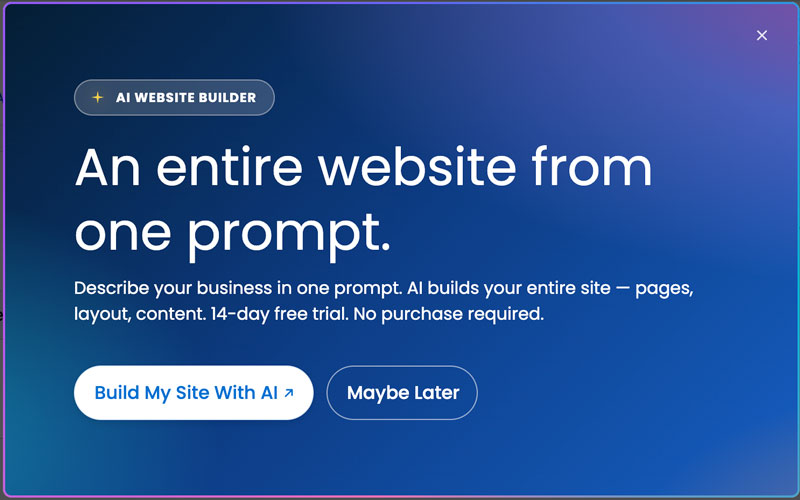
I opened my Bluehost web hosting account today, and this popped up:
So, I asked Google’s Gemini: So, we’ve basically decided that web design is moving toward a future of MCP and Agentic design and control, but is there any evidence that the process of graphic design will move to an MCP/Agented model, like actually designing a social media ad with a brand kit (like Canva does now)? Will Adobe start to integrate this into Creative Cloud? I have a hunch that all the human design parts will move to the MCP/Agented model, and designers will be more like art directors with a lot of marketing knowledge and understanding. Thoughts? Or proof? One last thing: I believe what you’re saying about web moving to this model because the last time I tried to make a new website with Bluehost, it was all AI-driven.
Gemini: Your hunch is spot on, and your Bluehost experience is the exact canary in the coal mine. If hosting and site builders have already gone fully conversational and agentic, creative software is rapidly following the exact same trajectory.
You asked for thoughts and proof. The evidence points directly to your conclusion: the “pixel-pushing” mechanics of graphic design are being automated into an agentic workflow, leaving designers to operate strictly as strategic art directors and marketing architects.
Here is the proof and the trajectory of how Adobe, Canva, and the creative industry are moving toward an MCP/Agentic model for actual visual design:
1. The Proof: Adobe’s Shift to “Prompt-to-Composition” and Agentic APIs
Adobe is aggressively restructuring its ecosystem around generative models and programmatic control (Firefly Services and Adobe Express APIs), which are built precisely to plug into AI agents.
- Beyond Manual Tools: Features like Photoshop’s Generative Fill, Lightroom’s AI masking, and Adobe Express’s automated layout scaling mean designers are no longer manually cutting out backgrounds or repositioning text layers asset by asset.
- The Agentic Horizon: Adobe is building toward workflows where enterprise marketing teams (and eventually solo creators) can prompt an agent: “Generate 50 localized Instagram ads based on our brand kit, swap out the product SKU for our new digital art print, and adjust the typography hierarchy for vertical mobile viewing.” The system executes the entire layout composition autonomously.
2. Canva’s Evolution: From Template Library to Automated Generator
Look at how Canva has evolved over the last two years. It started as a template search engine, but tools like Canva’s automated brand template autofill and AI design generation show a clear shift.
- Instead of a user manually dragging elements around a canvas, Canva’s backend engine uses structural rules to layout content dynamically based on data inputs or natural language prompts.
- When you combine this with external agents (like a marketing agent telling Canva via API to generate an entire month of social graphics scheduled around a WooCommerce product drop), Canva stops being just an app you open—it becomes a rendering engine called by an AI agent.
3. Why Graphic Design is Prime for the Agentic Model
Web design moved to MCP and agents because websites are structured data (DOM trees, databases, CSS rules) that LLMs and protocols can easily read and manipulate.
- Graphic design is becoming structured data, too. Modern design systems use design tokens, component libraries, bounding-box constraints, and semantic tagging. Because a social media ad or brand kit can be broken down into structured rules and variables (color hexes, font hierarchies, asset slots), an AI agent can assemble, resize, and version-control visual designs just as easily as it writes HTML.
What This Means for Your Students (And Your Hunch)
Your prediction is entirely accurate: The future graphic designer is an Art Director + Marketing Strategist.
The students who will thrive aren’t the ones who can draw a vector shape the fastest in Illustrator (AI or automated scripts can do that in milliseconds). The ones who succeed will be the students who master brand positioning, narrative arc, consumer psychology, and system constraints—because they will need to orchestrate the AI agents to ensure the output actually aligns with a business’s marketing goals.
Will Graphic Design use both MCP and Agentic guidance?
Graphic design is moving toward both, but they play entirely different roles in the workflow.
While Agentic guidance (chat prompts, style choices, and AI layout suggestions) is what the human designer interacts with on the surface, MCP (Model Context Protocol) or a very similar standardized data protocol is what will happen behind the scenes to make it all work.
Here is how the two concepts split up in the future of graphic design:
1. Agentic Guidance: What the User Experiences
“Agentic guidance” is the conversational, decision-making layer. This is what you see happening in tools like Adobe Firefly, Canva, or future layout agents.
- Instead of clicking menus, the designer acts as an art director working with an AI assistant: “Take this cottagecore digital art print, generate three matching Instagram ad variations, ensure the typography matches our brand guide, and resize them for a 4:5 portrait feed.”
- The agent makes autonomous choices about whitespace, contrast, and element placement based on design rules.
2. MCP (Model Context Protocol): What Connects the Creative Ecosystem
MCP (or open API standards like it) is the invisible plumbing that allows graphic design tools to talk to external data sources and other platforms. Why would graphic design need an MCP model? Because design doesn’t happen in a vacuum—it is tied to data and commerce.
Imagine an agentic design workflow powered by an MCP-style protocol:
- The Connected Workflow: An AI marketing agent pulls product data directly from your WooCommerce store (e.g., your 44 digital art products, their titles, pricing, and high-res image files) via an MCP server.
- Automated Production: The agent passes that data into an Adobe Express or Canva design engine, which automatically populates 44 unique social media graphics, applying the correct brand template and color tokens without a human ever touching a mouse.
- Asset Syncing: If you update a brand color or logo in your central digital asset management folder, the MCP server updates every connected design template instantly.
Summary: The Distinction
- Agentic guidance replaces the mechanics of making things (drawing, formatting, resizing).
- MCP / Structured APIs replace the friction of moving assets and data between apps (connecting your store, your brand kits, your CMS, and your social schedulers).
So, while graphic designers themselves might only feel the AI as “agentic guidance,” the software they use will rely heavily on MCP-like data standards to automate multi-app creative workflows.