Quick Links to the 5 Strategies for Student Success
These five categories bring together complementary research-based approaches into one research-informed educational framework:
- Adult Learning & Motivation
- Cognitive Load & Effective Instruction
- Modeling, Scaffolding & Guided Practice
- Universal Design for Learning (UDL)
- Active Learning, Feedback & Reflection
VANS Shoes Marketing Campaign – Example
Here’s an example of how this teaching and learning strategy is used in my Design Fundamentals class as students create and design a Marketing Campaign from the ground up. The VANS example below is meant to inspire students and give them a concrete sense of the project’s expectations while allowing them to retain some choice and flexibility.
Several guided steps and mini-projects combine to create a portfolio-quality, client-ready marketing campaign that helps them get their first job and demonstrate their in-depth understanding of the fusion of graphic design and marketing.
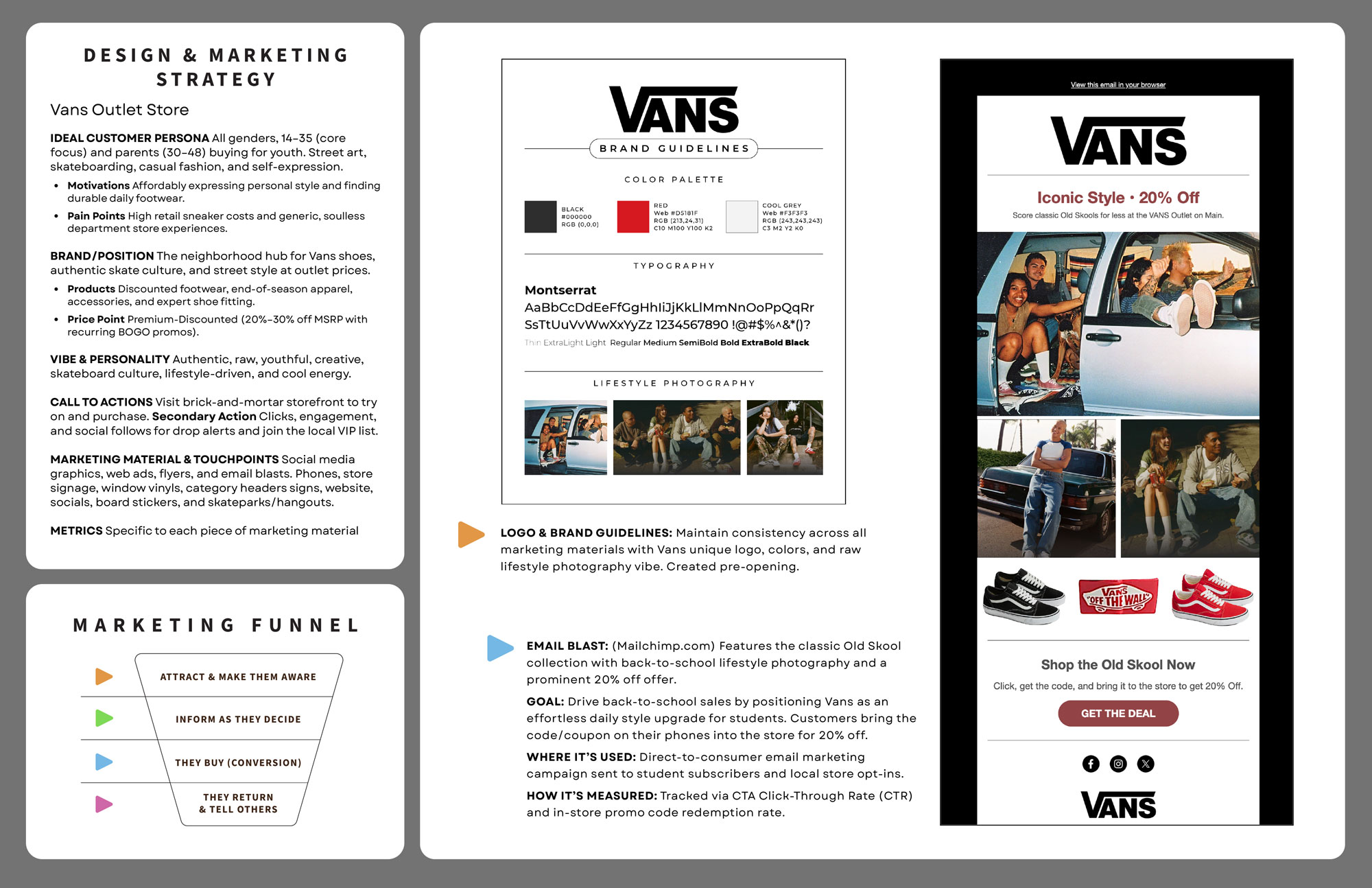
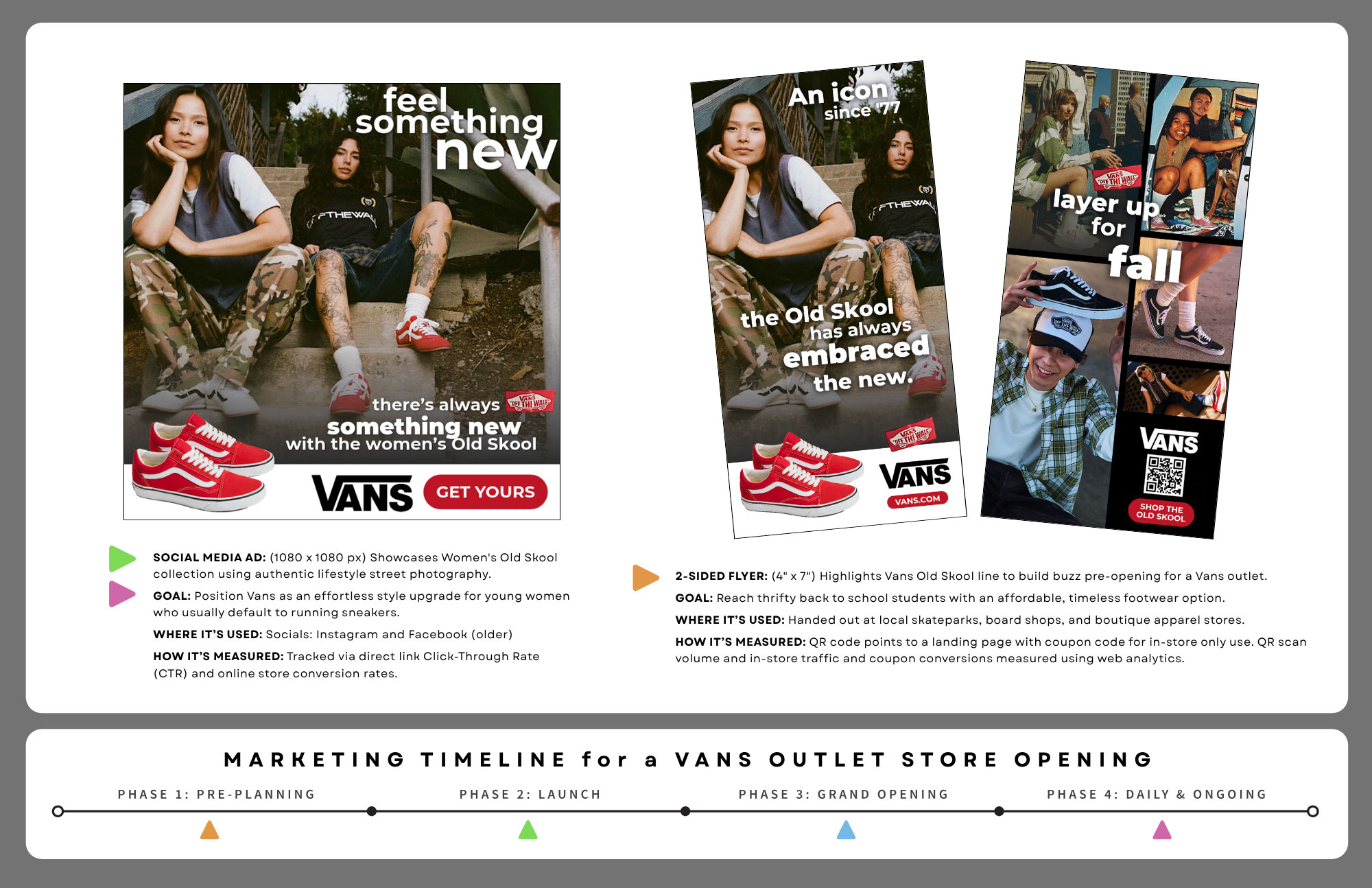
How it is used in the VANS Marketing Campaign Project
- Apply, don’t just read: Students apply marketing funnel concepts and metrics directly to their own designs and explain their decisions on their portfolio spread. (View Here)
- Self-checklists: Every assignment page includes a clear grading checklist so students can inspect their own files, including size, format, and branding, before turning them in. (View Here)
- Clear targets: The “4 Levels of Graded Design Work” shows students the difference between beginner work and client-ready work so they understand what they are working toward. (View Here)
- Solution-focused feedback: Instructor critiques identify strengths and areas for improvement, then provide practical suggestions and possible design solutions. Students can use the written and visual feedback to decide what to try next. (View Here)
- Progress and revision: Students have opportunities to apply feedback, revise their designs, and compare their earlier work with improved versions. This makes learning and progress visible.
- Critiques and presentations: Students participate in peer critiques and present their campaigns, explaining their strategy and design decisions. This encourages reflection, thoughtful evaluation, and learning from others.
(View Here)
5. Active Learning, Formative Assessment & Solution-Focused Feedback
Keep Students Practicing, Improving & Moving Forward
Give students regular opportunities to apply what they’re learning, evaluate their progress, receive practical feedback, and make meaningful improvements.
What it means for teachers
- Students learn by actively applying what they’ve learned rather than only reading or listening.
- Regular progress checks help instructors identify where students need additional guidance.
- Useful feedback identifies what is working and offers practical suggestions for what to try next.
- Showing students possible solutions makes feedback easier to understand and apply.
- Checklists help students monitor their own progress and take responsibility for completing their work.
- Students need opportunities to practice, revise, and recognize how their work improves over time.
Academic Foundation
Research on Active Learning demonstrates that students benefit from participating in meaningful learning activities rather than relying entirely on passive listening. Applying knowledge, solving problems, discussing ideas, and practicing skills help students become active participants in their own learning.
A major 2014 meta-analysis by Scott Freeman and colleagues examined 225 studies comparing traditional lecturing with active learning in undergraduate science, technology, engineering, and mathematics courses. The researchers found improved examination performance and lower failure rates in active-learning courses.
Formative Assessment research emphasizes the importance of checking student understanding throughout the learning process rather than relying only on final evaluations. This allows instructors and students to identify what is working, recognize areas that need attention, and make adjustments before the work is finished.
Feedback research further suggests that feedback is most useful when it helps students understand their current performance and identify specific actions they can take to improve. David Nicol and Debra Macfarlane-Dick’s work on formative assessment highlights the importance of helping students develop the ability to evaluate their own work and regulate their learning.
Together, these findings support a classroom approach where students regularly practice, receive useful feedback, evaluate their progress, and apply suggestions to improve their work. Feedback becomes part of the learning process rather than simply a judgment of the finished product.
Read the Research:
- Active Learning Increases Student Performance in Science, Engineering, and Mathematics – PNAS (2014), Freeman et al.
- Test-Enhanced Learning: Taking Memory Tests Improves Long-Term Retention – Psychological Science (2006), Roediger & Karpicke
- The Power of Testing Memory: Basic Research and Implications for Educational Practice – Perspectives on Psychological Science (2006)
- Formative Assessment and the Design of Instructional Systems – Nicol & Macfarlane-Dick (2006)
Note: The Freeman meta-analysis focused on undergraduate STEM courses, so its specific numerical findings should not be generalized directly to every technical college program. Retrieval practice research focuses specifically on memory and recall, while formative assessment research addresses feedback and improvement. Together, these bodies of research support different but complementary parts of this instructional approach.