

Effective teaching isn’t about being a perfect instructor. It’s about making thoughtful choices that help students succeed.
- Use research to inform your teaching
- Use experience to guide your decisions
- Use student progress to evaluate whether your approach is working
These five strategies are not soley about improving as an instructor. They are built around how students learn, how instructors can make learning manageable, and how to support students as they develop new skills.
A Research-Informed Approach to Teaching
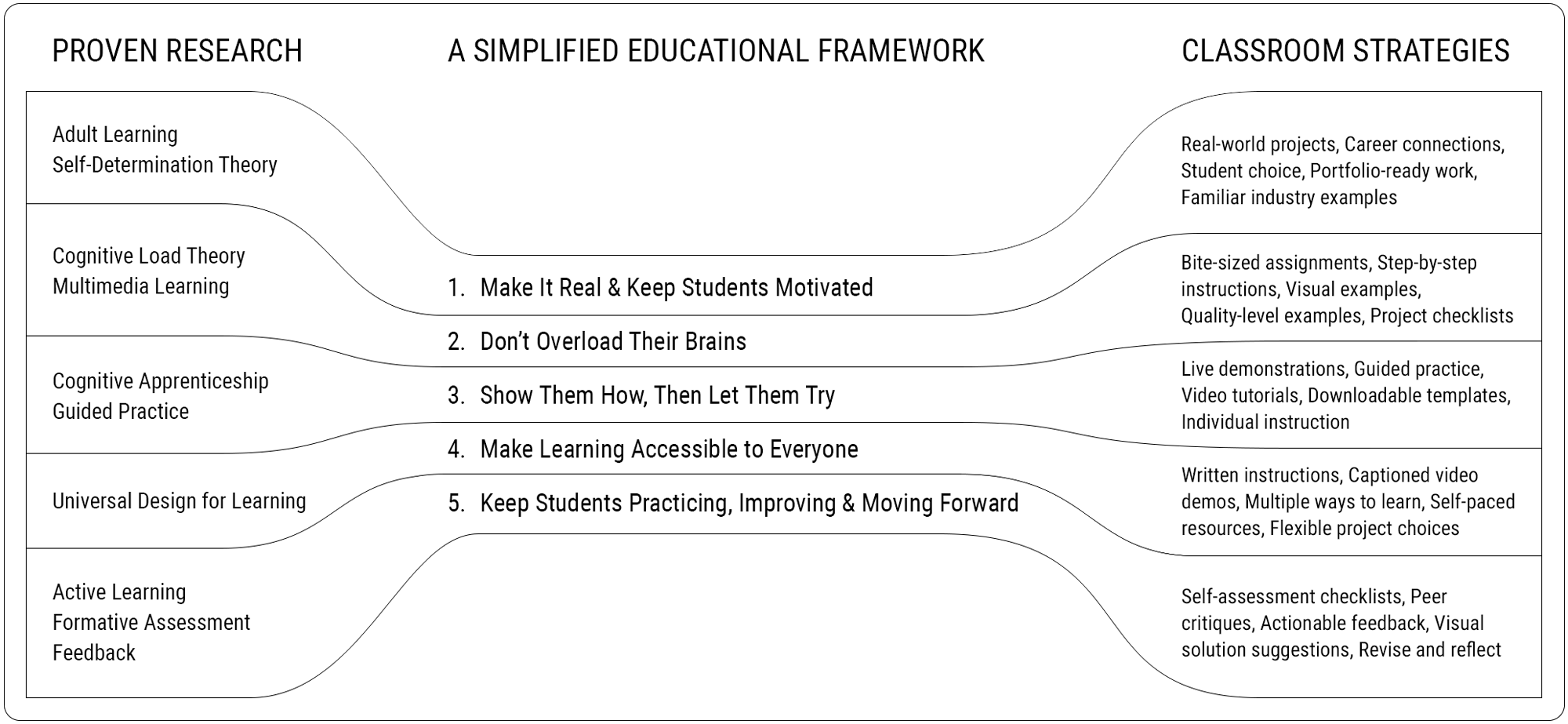
These five teaching and learning strategies bring together established educational theories and research into practical approaches instructors can use in their classrooms. They aren’t intended to represent five separate teaching programs or a one-size-fits-all formula. Instead, they provide a framework for making learning more engaging, manageable, accessible, and effective. Instructors can adapt the strategies to their subject areas, students, and teaching styles.
- Student-centered teaching & learning focuses on students’ needs, experiences, interests, and goals, giving them an active role in their learning.
- Inclusive teaching & learning creates a learning environment where students feel welcomed, respected, valued, and able to participate.
- Accessible teaching & learning makes learning understandable and achievable by anticipating different learning needs, providing flexible ways to learn, and reducing unnecessary barriers.
Each of these five strategies is based on established educational research.
| Academic Foundation | Teaching Strategy | What Research Generally Supports |
|---|---|---|
| Adult Learning & Self-Determination Theory | Make It Real & Keep Students Motivated | Relevance, meaningful choices, and a sense of competence can support student motivation. |
| Cognitive Load Theory & Multimedia Learning | Don’t Overload Their Brains | Breaking complex information into manageable pieces and using well-designed examples can support learning. |
| Cognitive Apprenticeship & Guided Practice | Show Them How, Then Let Them Try | Modeling, guided practice, and gradually reducing support help learners develop skills. |
| Universal Design for Learning | Make Learning Accessible to Everyone | Providing flexible ways to access information, participate, and demonstrate learning can help reduce barriers. |
| Active Learning, Formative Assessment & Feedback | Keep Students Practicing, Improving & Moving Forward | Applying knowledge, checking progress, and receiving useful feedback support learning and improvement. |
The Human Side of Teaching: Enthusiasm and Care
First things first: before we jump into the 5 strategies, it’s good to remember that we are humans first and that:
Students need instructors who care about what they teach and care about the people they’re teaching.
Effective teaching involves more than knowing your subject and delivering good instruction. Students also respond to the person teaching them.
When instructors genuinely enjoy their subject and communicate why it matters, they can help students develop interest, curiosity, and motivation to learn. When students recognize that their instructor respects them, believes in their abilities, and genuinely wants them to succeed, they are more likely to feel supported and be willing to work through challenges.
These qualities don’t require instructors to be entertainers or to become personal counselors. They come through in everyday teaching:
- Sharing your enthusiasm for the field
- Taking an interest in student progress
- Providing helpful and actionable feedback
- Being approachable, considerate, yet expectant
- Showing students that their efforts matter
Overview: Research Meets Classroom Practice
These five categories are not intended to be five separate teaching methods or a rigid formula for classroom instruction. They represent complementary principles that instructors can combine when planning lessons, designing projects, and supporting students.
The VANS Marketing Campaign Project example (below) demonstrates how these principles can work together within a single learning experience:
- Students understand why their work matters because it connects to real jobs and career opportunities.
- Complex assignments become manageable through smaller steps, clear instructions, and visual examples.
- Students develop practical skills through demonstrations, guided practice, and increasing independence.
- Different learning needs are anticipated through flexible resources, recorded tutorials, and project choices.
- Students strengthen their skills through application, self-assessment, constructive feedback, and reflection.
The purpose of introducing these strategies to new faculty is not to add unnecessary complexity to teaching. It is to help instructors make informed instructional decisions that improve the learning experience.
Many instructors already use some of these approaches naturally. Understanding the research behind them helps explain why they work, build confidence in their abilities (“I already do some of this naturally—I’m a natural teacher, but can still improve”), recognize opportunities to improve instruction, and develop a more intentional approach to teaching.
The ultimate goal is simple: Help instructors become better at helping students learn.
Five Research-Informed Strategies for Student Success
This tutorial explores how five research-based teaching and learning strategies can improve student learning, engagement, and success. Each strategy is presented in an accessible format and illustrated through its application in a real college graphic design project: the VANS Marketing Campaign.
The framework draws from established research in cognitive psychology, adult education, motivation, instructional design, and learning sciences. Rather than asking new instructors to become experts in educational theory, it translates these research findings into practical teaching approaches they can use in their own classrooms.
To see these five strategies applied to several graphic design classroom projects (in plain language), check out these links:
- VANS Shoes Marketing Campaign (Design Fundamentals class)
- Aurora Interior Designers Marketing Campaign (Digital Content Creation class)
- Windhill Studios Marketing Campaign (Web Design for Small Business class)
Why These Five Strategies?
Educational research consistently demonstrates that effective instruction involves more than delivering information. Students benefit from instruction that manages the demands placed on their working memory, connects learning to meaningful applications, provides appropriate guidance, accommodates differences among learners, and creates opportunities for active practice and feedback.
These five categories bring together complementary research-based approaches into one research-informed educational framework:
- Adult Learning & Motivation: Connect learning to real-world applications and support student motivation through choice, confidence, and meaningful goals.
- Cognitive Load & Effective Instruction: Make learning manageable by organizing information, reducing unnecessary complexity, and using effective visual and verbal instruction.
- Modeling, Scaffolding & Guided Practice: Demonstrate skills, provide structured support, and gradually develop student independence.
- Universal Design for Learning (UDL): Anticipate differences among learners and provide flexible ways to access information and demonstrate learning.
- Active Learning, Feedback & Reflection: Strengthen learning through practice, retrieval, constructive feedback, and self-assessment.
Together, these approaches provide a practical foundation for new technical college instructors, particularly those entering education with strong industry experience but limited formal training in instructional methods.
How These Five Support Inclusive and Equitable Strategies
Inclusive teaching strategies should be a lens through which instructors apply these five strategies.
Good teaching is inclusive teaching.
Students bring different experiences, abilities, interests, and levels of preparation into our classrooms. Our job is to make learning meaningful, understandable, accessible, and achievable while maintaining high expectations.
These five strategies help us do that.
We don’t assume that every student arrives ready to learn in the same way, at the same pace, or with the same background knowledge. So when designing our classes, we should think about these at every level.
1. Adult Learning & Motivation
Inclusive teaching connection: Recognizing students as individuals with different experiences, goals, interests, and reasons for learning.
- Connect new learning to students’ lives, experiences, interests, and career goals.
- Explain why something matters and how it applies to their future.
- Give students opportunities to make choices and take ownership of their learning.
- Build confidence through encouragement, relevance, and achievable challenges.
- Recognize that students arrive with different levels of preparation and confidence.
The equity connection: Students are more likely to engage when they can see a reason to learn and feel that their experiences and goals matter in the classroom.
2. Cognitive Load & Effective Instruction
Inclusive teaching connection: Making learning easier to understand and reducing unnecessary barriers that can overwhelm students.
- Break complex information and assignments into manageable steps.
- Use clear, straightforward instructions and avoid unnecessary jargon.
- Organize information so students can focus on what matters most.
- Provide examples and visual explanations to support understanding.
- Avoid overwhelming students with too much new information at once.
The equity connection: Students don’t all arrive with the same background knowledge or experience. Clear instruction and manageable learning steps help more students access challenging material without lowering expectations.
3. Modeling, Scaffolding & Guided Practice
Inclusive teaching connection: Providing the instruction, examples, practice, and support students need to develop new skills.
- Demonstrate how to complete a task rather than simply explaining it.
- Break unfamiliar processes into smaller steps.
- Provide guided practice before expecting independent work.
- Give students opportunities to ask questions and try again.
- Gradually reduce support as students become more confident and capable.
The equity connection: Students who have less prior experience shouldn’t be expected to figure everything out on their own. Providing a path from demonstration to independent practice gives more students a reasonable opportunity to succeed.
4. Universal Design for Learning (UDL)
Inclusive teaching connection: Anticipating that students learn differently and providing flexible ways to access information, engage with learning, and demonstrate understanding.
- Present information in different ways, such as demonstrations, visuals, written instructions, and discussion.
- Provide different ways for students to engage with course material.
- Offer appropriate flexibility in how students demonstrate their learning when it doesn’t compromise the learning outcome.
- Build accessibility into course materials from the beginning.
- Give students meaningful choices and opportunities to take ownership of their learning.
The equity connection: Instead of waiting for students to struggle and then making adjustments, UDL encourages instructors to anticipate common barriers and design more accessible learning experiences from the start.
5. Active Learning, Feedback & Reflection
Inclusive teaching connection: Giving students opportunities to participate, practice, receive useful feedback, and recognize their progress.
- Use activities that get students involved rather than relying entirely on lectures.
- Provide opportunities for peer discussion, collaboration, and shared learning.
- Give students specific, actionable feedback they can use to improve.
- Create opportunities to revise work and learn from mistakes.
- Help students reflect on their progress and recognize what they’re capable of accomplishing.
The equity connection: Students need opportunities to demonstrate what they’re learning, receive guidance, and improve—not just be evaluated on a single attempt. Regular feedback and practice give more students a chance to succeed.
These five strategies address inclusion in different ways
| What inclusive teaching asks instructors to do | Where it already appears |
|---|---|
| Make learning relevant and meaningful | Adult Learning & Motivation |
| Communicate clearly and reduce unnecessary barriers | Cognitive Load & Effective Instruction |
| Provide support as students develop new skills | Modeling, Scaffolding & Guided Practice |
| Anticipate differences and offer flexible learning experiences | Universal Design for Learning |
| Give students opportunities to participate, improve, and demonstrate learning | Active Learning, Feedback & Reflection |
These strategies can also reinforce one another. UDL, for example, isn’t confined to strategy 4. You can use UDL principles when designing a demonstration, breaking down a complicated assignment, providing feedback, or giving students choices in a project.
One Important Distinction
These five strategies cannot cover every possible aspect of equity and inclusion. There are important additional considerations, such as:
- Recognizing and addressing unconscious assumptions or biases.
- Making sure classroom discussions and group activities allow everyone to participate respectfully.
- Using examples and course materials that reflect a range of people and experiences.
- Recognizing when policies or classroom practices unintentionally disadvantage certain students.
- Understanding accessibility and accommodation responsibilities.
We should consider these in all five strategies and view them through the lens introduced earlier.
For example, when using active learning, an instructor can think about whether everyone has a reasonable opportunity to contribute. When choosing examples, an instructor can consider whether students can relate to them. When designing an assignment, an instructor can consider whether an unnecessary requirement is getting in the way of the actual learning objective.
Interesting Reading
An article, co-authored by a University of Wisconsin–Madison researcher:
Moreu and Brauer (2022): Inclusive Teaching Practices in Post-Secondary Education.
Gil Moreu and Markus Brauer identify 20 practical teaching strategies that research has associated with improved student experiences and, in some cases, narrower achievement gaps.
Some of their recommendations might sound familiar:
- Learn students’ names.
- Provide motivating, actionable feedback.
- Connect course material to students’ lives and career goals.
- Use active learning and low-stakes practice.
- Provide captions for videos.
- Give students opportunities to get to know one another.
- Establish classroom expectations that encourage participation.
- Avoid putting students on the spot as representatives of an entire social group.
Many of these are simply good teaching practices. The authors also make an important qualification: no single classroom practice can eliminate achievement gaps caused by larger social and institutional factors.