
AI literacy is no longer about learning ChatGPT. It’s about learning how to work with AI while keeping humans in charge.
AI can help generate ideas, content, and information. Human value comes from understanding the audience, making decisions, solving problems, and determining whether the output actually accomplishes its goal.
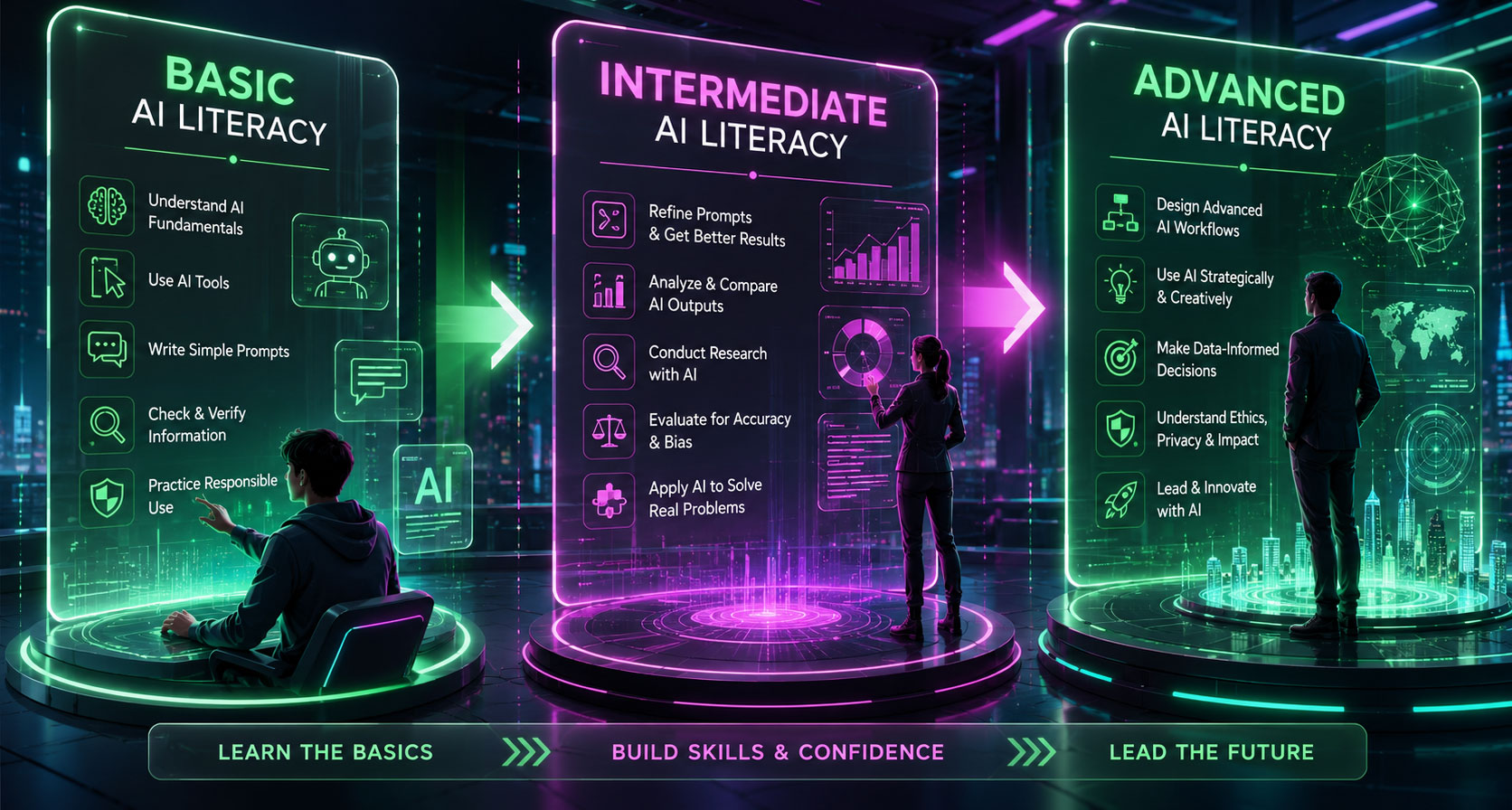
Basic AI Literacy
AI User
“I know how to use AI responsibly.”
Students should be able to…
- Explain what AI is—and what it is not
- Understand AI’s strengths and limitations
- Write clear, specific prompts
- Use AI for brainstorming and idea generation
- Summarize and organize information with AI
- Improve writing, grammar, and communication
- Generate simple images and visual concepts
- Recognize AI “hallucinations” (incorrect or fabricated information)
- Verify facts before trusting AI output
- Follow ethical and academic guidelines
- Protect personal and confidential information
- Cite AI appropriately when required
Intermediate AI Literacy
AI Collaborator
“I know when—and how—to use AI.”
Students should be able to…
- Refine prompts through multiple iterations
- Compare AI responses and choose the best solution
- Conduct in-depth research using AI
- Request citations and verify sources
- Analyze trends and summarize large amounts of information
- Combine ideas from multiple disciplines
- Use AI to solve business or design problems
- Adapt AI output for different audiences
- Recognize bias and incomplete information
- Edit AI work to improve accuracy, quality, and tone
- Select the right AI tool for different tasks
- Explain why they accepted or rejected AI suggestions
Advanced AI Literacy
AI Decision-Maker
“I lead AI instead of following it.”
Students should be able to…
- Develop complex prompting strategies
- Break large projects into AI-assisted workflows
- Evaluate AI recommendations using human judgment
- Make decisions based on evidence—not AI confidence
- Use AI to support strategic thinking and innovation
- Analyze business opportunities and future trends
- Automate repetitive tasks while maintaining quality
- Consider legal, ethical, and privacy implications
- Communicate AI-assisted decisions to coworkers or clients
- Use AI as one tool within a larger problem-solving process
- Know when not to use AI
- Take responsibility for the final outcome
Human Skills That Become More Important
Every major framework—and nearly every employer survey—emphasizes that AI increases the value of uniquely human skills rather than replacing them.
Students should continue developing:
- Critical thinking
- Problem solving
- Communication
- Creativity
- Emotional intelligence
- Teamwork
- Ethical decision-making
- Adaptability
- Professional judgment
- Lifelong learning
These are the skills that guide AI—not the other way around.
A Simple Rule to Remember
As students progress, their relationship with AI should evolve:
| Level | Mindset |
|---|---|
| Basic | “AI helps me complete tasks.” |
| Intermediate | “AI helps me think through problems.” |
| Advanced | “I decide when, why, and how AI should be used.” |
The goal isn’t to become dependent on AI—it’s to become someone who can direct AI effectively while remaining accountable for the results.
Resources
- U.S. Department of Labor — Artificial Intelligence Literacy Framework (2026)
A workforce-focused framework developed specifically for employment, community colleges, apprenticeships, and career readiness. U.S. Department of Labor AI Literacy Framework - OECD & European Commission — Empowering Learners for the Age of AI (2026)
One of the newest international AI literacy frameworks, emphasizing knowledge, skills, attitudes, ethics, and critical evaluation.
OECD AI Literacy Framework - UNESCO — AI Competency Framework for Students
A globally recognized framework organized around four dimensions (human-centered mindset, ethics, AI techniques, and AI system design) with progression from Understand → Apply → Create.
UNESCO AI Competency Framework for Students - OECD — AI and Skills: What We Know So Far (2026)
Summarizes current evidence on how AI is changing workforce skill demands, including greater emphasis on data interpretation, high-level thinking, and continuous training.
OECD AI and Skills Report - EDUCAUSE Review — A Framework for AI Literacy
A practical higher-education framework that scaffolds AI literacy through four stages: Understand AI → Use & Apply → Analyze & Evaluate → Create AI.
EDUCAUSE AI Literacy Framework