Quick Links to the 5 Teaching and Learning Strategies
These five categories bring together complementary research-based approaches into one research-informed educational framework:
- Adult Learning & Motivation
- Cognitive Load & Effective Instruction
- Modeling, Scaffolding & Guided Practice
- Universal Design for Learning (UDL)
- Active Learning, Feedback & Reflection
VANS Shoes Marketing Campaign – Example
Here’s an example of how this teaching and learning strategy is used in my Design Fundamentals class as students create and design a Marketing Campaign from the ground up. The VANS example below is meant to inspire students and give them a concrete sense of the project’s expectations while allowing them to retain some choice and flexibility.
Several guided steps and mini-projects combine to create a portfolio-quality, client-ready marketing campaign that helps them get their first job and demonstrate their in-depth understanding of the fusion of graphic design and marketing.
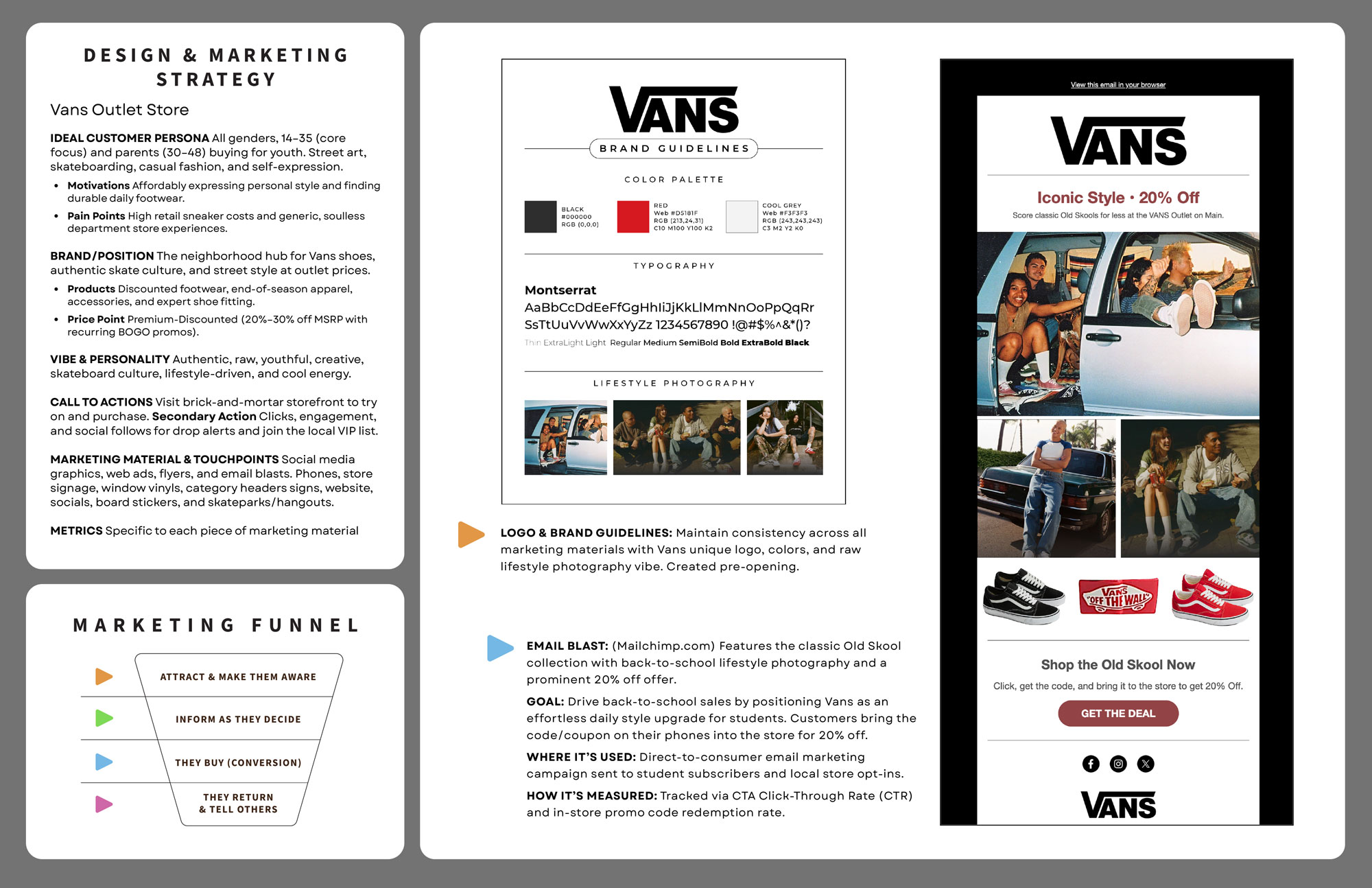
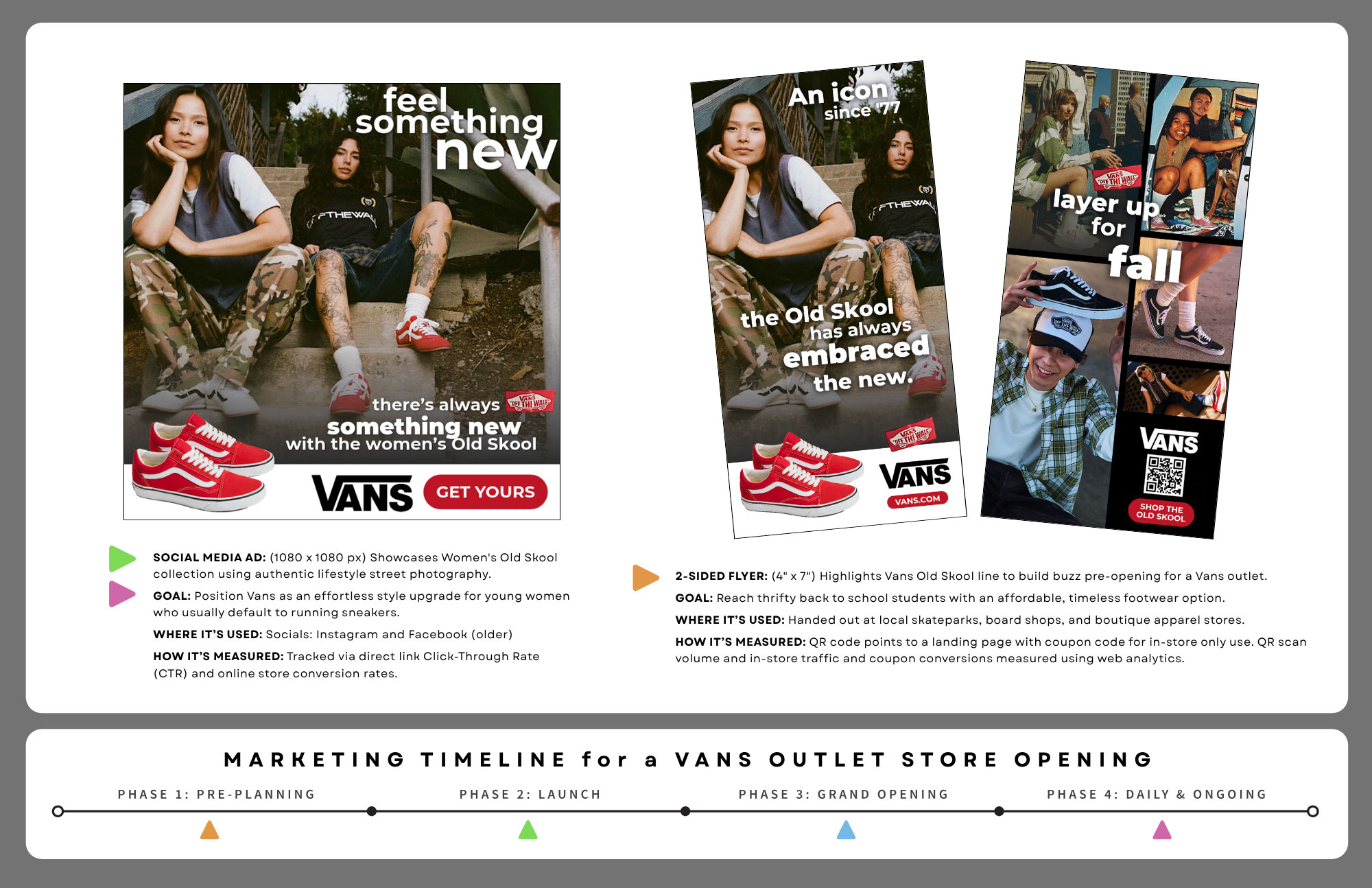
How it is used in the VANS Marketing Campaign Project
- Multiple ways to access instructions: Students can follow step-by-step written website instructions, view visual design examples, and watch video demonstrations to learn Canva workflows and layout techniques.
- Flexible learning pace: Video tutorials (like the “How to use Canva” walkthrough) allow students to pause, rewind, and review software steps independently at their own pace.
- Multiple ways to learn: The project combines live instructor demonstrations, hands-on practice, visual examples, and instructor feedback to support students with different learning needs.
- Flexible student expression: Students can choose their own client or brand, select which three marketing pieces to design (such as a flyer, web ad, or email), and decide whether to build their layouts in Canva or Adobe Illustrator to demonstrate their skills.
4. Universal Design for Learning (UDL)
Make Learning Accessible to Everyone
Build flexibility into your teaching by providing different ways for students to access information, learn new skills, participate, and demonstrate what they know.
What it means for teachers
- Students don’t all learn, process information, or demonstrate understanding in the same way. One teaching approach won’t work equally well for everyone.
- If you primarily lecture, consider adding visual examples, short tutorial videos, demonstrations, or written instructions.
- If you demonstrate something in class, consider recording it so students can revisit the process when they need help or miss a step.
- Give students reasonable choices in how they approach assignments and demonstrate their skills while still meeting the same learning goals.
- Look at where students commonly struggle. Sometimes a new handout, video, example, checklist, or alternative explanation is all that’s needed.
- You don’t have to create everything at once. Start with one lesson or one learning barrier and gradually build helpful resources.
Academic Foundation
Universal Design for Learning (UDL) developed from the broader universal design movement in architecture and product design. Its educational framework was pioneered by David Rose, Anne Meyer, and their colleagues at CAST (Center for Applied Special Technology) during the 1990s.
UDL recognizes that students bring different abilities, experiences, backgrounds, and learning needs into the classroom. Rather than designing instruction for an imagined average student and making accommodations only after someone struggles, UDL encourages instructors to anticipate potential learning barriers and build flexibility into instruction from the beginning.
The framework is organized around three principles:
- Multiple Means of Engagement: Provide different ways to motivate and involve students in learning.
- Multiple Means of Representation: Present information in different ways so students can access and understand it.
- Multiple Means of Action & Expression: Provide appropriate flexibility in how students practice and demonstrate their learning.
The current CAST Guidelines (Version 3.0, 2024) expand on these principles and emphasize reducing barriers and designing learning environments that support a wider range of learners.
Read the Research:
- Universal Design for Learning Guidelines 3.0 – CAST (2024)
- Universal Design for Learning: Theory and Practice – CAST
- CAST – About Universal Design for Learning
UDL: A Practical Approach to Adopting It
UDL doesn’t mean instructors must completely redesign their courses or create three different versions of every lesson. It means examining existing instruction and considering whether students have enough ways to access, understand, practice, and demonstrate what they’re learning.
Sometimes this will mean creating something new. If an instructor relies entirely on lectures, for example, adding a short tutorial video, a visual demonstration, or a written step-by-step handout could make a significant difference.
Traditional approach: I explain something to the class. Everyone receives the same explanation, in the same way, at the same time.
UDL approach: I explain and demonstrate something, but I also provide resources students can return to, different ways to understand the material, and reasonable flexibility in how they learn and demonstrate their skills.
For example:
| If you currently… | Consider adding… |
|---|---|
| Lecture about a topic | A visual presentation, short video, or reading handout |
| Demonstrate software in class | A recorded tutorial students can revisit |
| Give verbal assignment instructions | Written instructions and visual examples |
| Assign the same creative approach to everyone | Reasonable choices in project direction or format |
| Give students one opportunity to practice | Guided practice, examples, and opportunities to try again |
| Evaluate only the final product | Checkpoints, feedback, and opportunities to improve |
Remember: UDL doesn’t mean lowering expectations or allowing students to avoid learning essential skills. It means removing unnecessary barriers so more students have a reasonable opportunity to meet the same learning goals.
You don’t have to become a different kind of teacher. You just have to become a little more flexible in how you help students learn.
Improve what you’re already doing without feeling you need to build an entirely new course.