
Quick Links to the 5 Teaching and Learning Strategies
These five categories bring together complementary research-based approaches into one research-informed educational framework:
- Adult Learning & Motivation
- Cognitive Load & Effective Instruction
- Modeling, Scaffolding & Guided Practice
- Universal Design for Learning (UDL)
- Active Learning, Feedback & Reflection
VANS Shoes Marketing Campaign – Example
Here’s an example of how this teaching and learning strategy is used in my Design Fundamentals class as students create and design a Marketing Campaign from the ground up. The VANS example below is meant to inspire students and give them a concrete sense of the project’s expectations while allowing them to retain some choice and flexibility.
Several guided steps and mini-projects combine to create a portfolio-quality, client-ready marketing campaign that helps them get their first job and demonstrate their in-depth understanding of the fusion of graphic design and marketing.
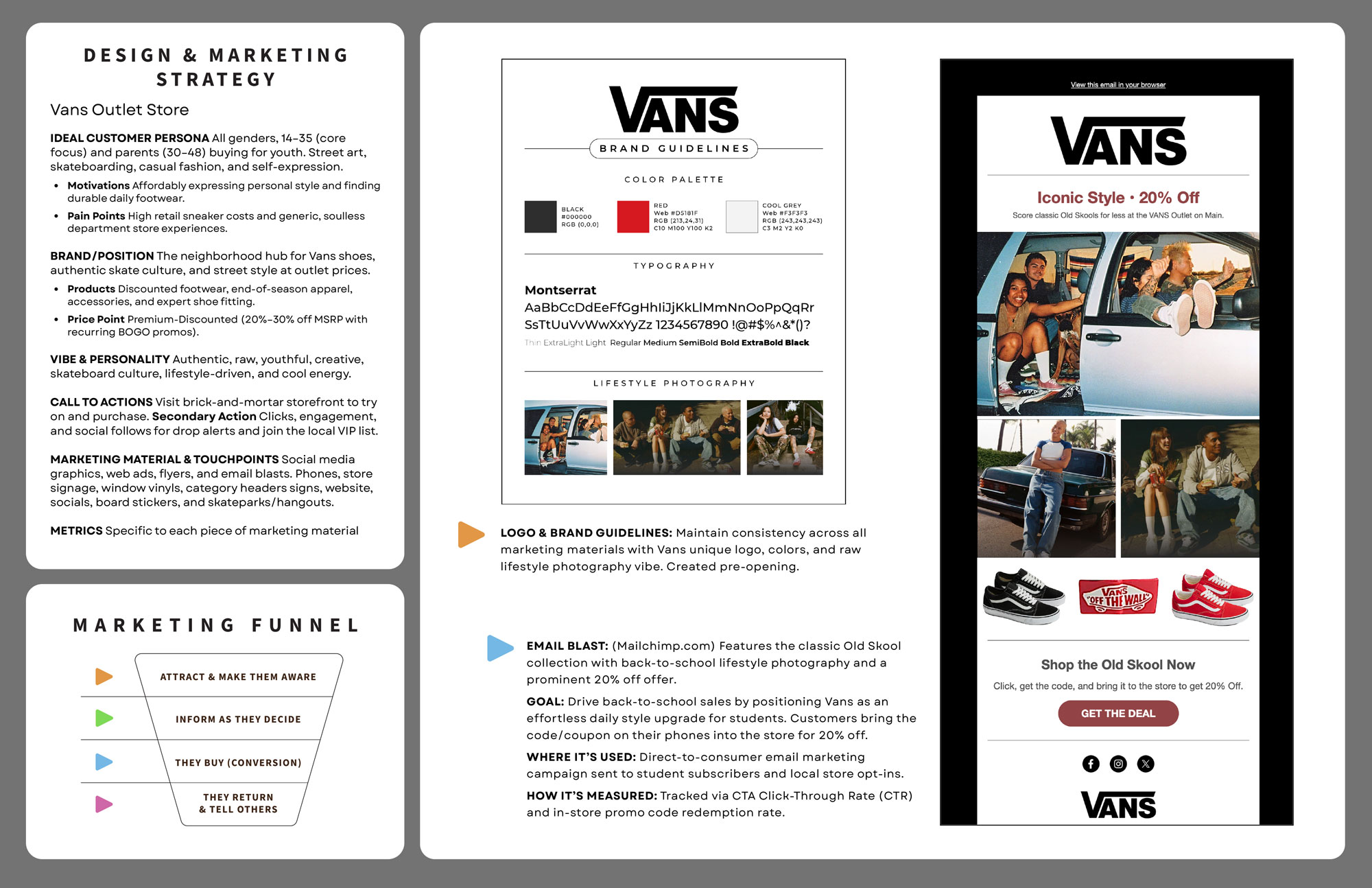

How it is used in the VANS Marketing Campaign Project
- Step-by-step chunking: The big campaign is broken into smaller pieces: strategy first, then brand guide, then three separate designs.
- Visual + text pairing: Every instruction page includes clear checklists alongside visual examples.
- Worked examples: Students see a complete sample campaign (the VANS Shoes example) and past student work before making their own.
- Beginner-friendly tools: Students can start in Canva instead of getting overwhelmed by advanced Adobe tools right away.
2. Cognitive Load & Effective Instruction
Don’t Overload Their Brains
Break big skills into smaller steps and pair clear visuals with simple instructions so beginners don’t get overwhelmed.
What it means for teachers
- Beginners can only process a limited amount of new information at a time.
- Pairing simple text with clear, relevant visuals can help students understand new information.
- Showing a finished example before students start helps remove confusion.
- Build skills gradually rather than expecting students to master everything at once.
Academic Foundation
Cognitive Load Theory originated in cognitive psychology and is primarily associated with educational psychologist John Sweller. His foundational research showed that working memory has limited capacity and that complex instructional tasks can overwhelm beginners before they develop the knowledge and skills needed to manage them.
Research in this area supports breaking complex information into manageable pieces, providing appropriate examples, and gradually introducing more challenging tasks.
Richard Mayer’s Cognitive Theory of Multimedia Learning further explains how people process verbal and visual information. His research supports carefully combining words and relevant images to help learners understand complex material. However, multimedia instruction must be designed thoughtfully; adding more information or visuals does not automatically improve learning.
Read the Research: