
Quick Links to the 5 Strategies for Student Success
These five categories bring together complementary research-based approaches into one research-informed educational framework:
- Adult Learning & Motivation
- Cognitive Load & Effective Instruction
- Modeling, Scaffolding & Guided Practice
- Universal Design for Learning (UDL)
- Active Learning, Feedback & Reflection
VANS Shoes Marketing Campaign – Example
Here’s an example of how this teaching and learning strategy is used in my Design Fundamentals class as students create and design a Marketing Campaign from the ground up. The VANS example below is meant to inspire students and give them a concrete sense of the project’s expectations while allowing them to retain some choice and flexibility.
Several guided steps and mini-projects combine to create a portfolio-quality, client-ready marketing campaign that helps them get their first job and demonstrate their in-depth understanding of the fusion of graphic design and marketing.
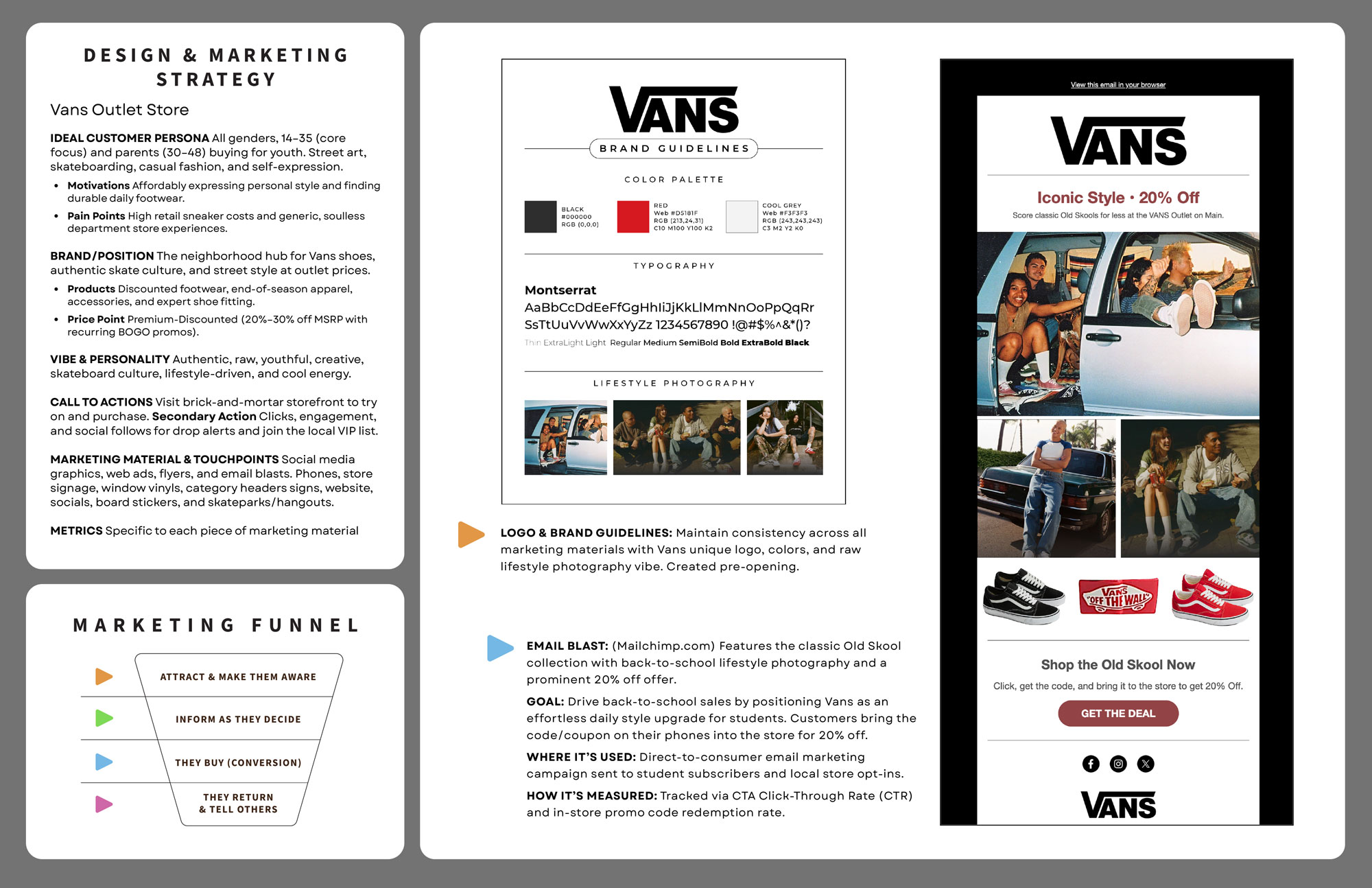
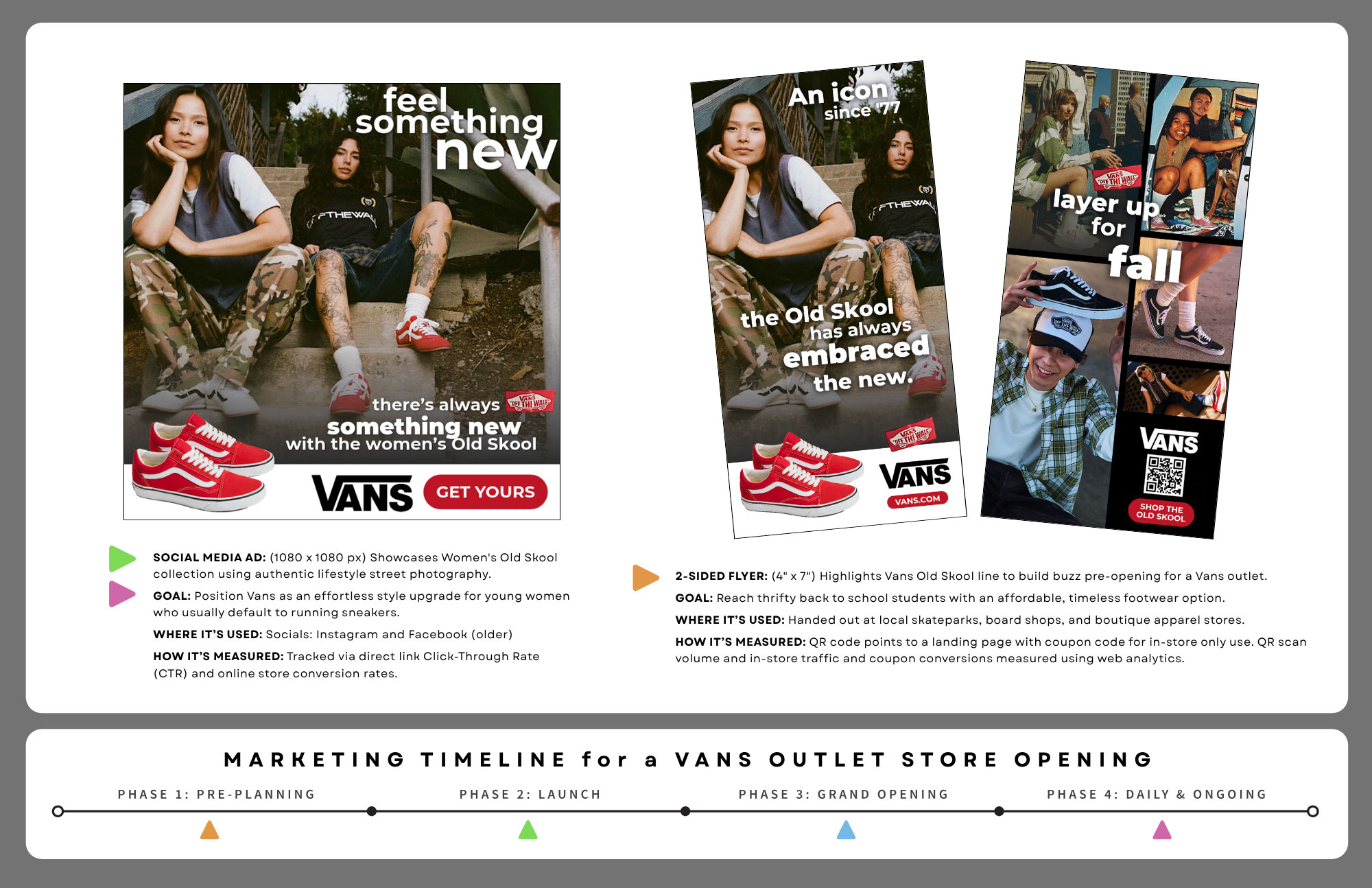
How it is used in the VANS Marketing Campaign Project
- Real job tasks: Students act like working designers—writing a strategy, following brand rules, and connecting visuals to a marketing funnel and metrics. (View Here)
- Job market proof: Instructions include real graphic design job postings showing that employers actually ask for these skills. (View Here)
- Student choice: Students pick their own client and choose three marketing pieces to design. (View Here)
- Portfolio-ready output: Every piece goes into a 2-page portfolio spread they can show during job interviews. (View Here)
1. Adult Learning & Motivation
Make It Real & Keep Students Motivated
Connect lessons to real jobs and practical problems. Help students understand why they’re learning something and give them opportunities to make choices and experience success.
What it means for teachers
- Career-focused students want to know why they’re learning something and how it applies to real jobs.
- Students are more engaged when they work on realistic problems instead of abstract assignments.
- Giving students choices and some control over their work can increase motivation.
- Small early successes build confidence and encourage students to keep improving.
Academic Foundation
Adult Learning (Andragogy) was popularized in the United States by adult education scholar Malcolm Knowles during the 1960s and 1970s. His work emphasized the importance of relevant, practical, experience-based learning and involving students in their own learning.
Self-Determination Theory (SDT), developed by psychologists Edward Deci and Richard Ryan, adds an important understanding of student motivation. Their research identifies three basic psychological needs that support motivation and engagement:
- Autonomy: Having some choice and control over learning.
- Competence: Feeling capable of making progress and succeeding.
- Relatedness: Feeling connected to instructors, classmates, and the learning environment.
Together, these perspectives suggest that students are more likely to engage when learning feels relevant, they have some ownership of their work, and they believe they can succeed.
Read the Research:
- The Adult Learner – Malcolm Knowles, Elwood Holton, and Richard Swanson
- Self-Determination Theory and the Facilitation of Intrinsic Motivation, Social Development, and Well-Being – American Psychologist (2000)
- A Psychological Critique of Knowles’ Andragogy as a Theory of Learning (2024)
Note: Andragogy is a useful instructional framework, but it should not be treated as proof that adults and younger learners learn in fundamentally different ways. Practical relevance, autonomy, and meaningful learning experiences can benefit students of all ages.