
Effective teaching isn’t about being a perfect instructor. It’s about making thoughtful choices that help students succeed.
- Use research to inform your teaching
- Use experience to guide your decisions
- Use student progress to evaluate whether your approach is working
A Research-Informed Approach to Teaching
These five teaching and learning strategies bring together established educational theories and research into practical approaches instructors can use in their classrooms. They aren’t intended to represent five separate teaching programs or a one-size-fits-all formula. Instead, they provide a framework for making learning more engaging, manageable, accessible, and effective. Instructors can adapt the strategies to their subject areas, students, and teaching styles.
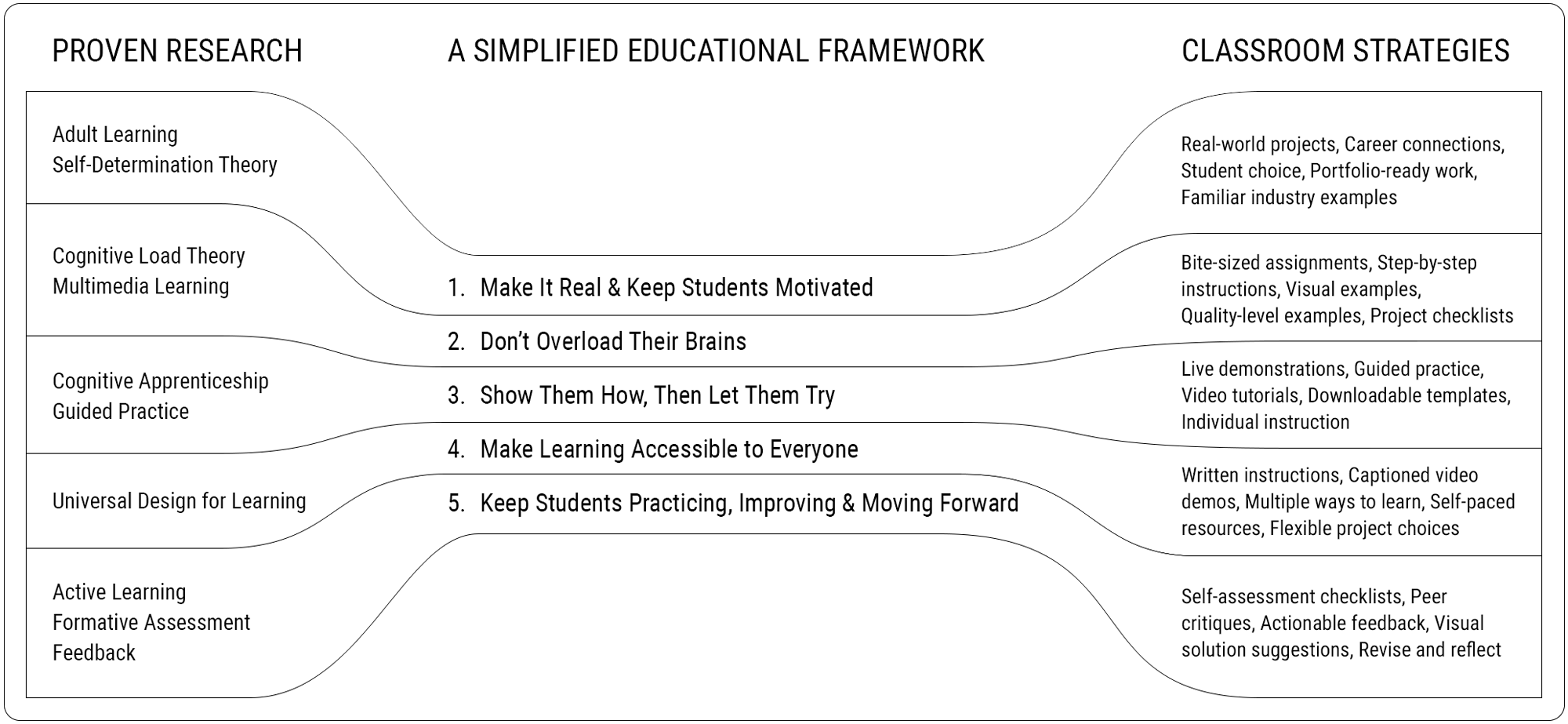
Each of these five strategies is based on established educational research.
| Academic Foundation | Teaching Strategy | What Research Generally Supports |
|---|---|---|
| Adult Learning & Self-Determination Theory | Make It Real & Keep Students Motivated | Relevance, meaningful choices, and a sense of competence can support student motivation. |
| Cognitive Load Theory & Multimedia Learning | Don’t Overload Their Brains | Breaking complex information into manageable pieces and using well-designed examples can support learning. |
| Cognitive Apprenticeship & Guided Practice | Show Them How, Then Let Them Try | Modeling, guided practice, and gradually reducing support help learners develop skills. |
| Universal Design for Learning | Make Learning Accessible to Everyone | Providing flexible ways to access information, participate, and demonstrate learning can help reduce barriers. |
| Active Learning, Formative Assessment & Feedback | Keep Students Practicing, Improving & Moving Forward | Applying knowledge, checking progress, and receiving useful feedback support learning and improvement. |
The Human Side of Teaching: Enthusiasm and Care
First things first: before we jump into the 5 strategies, it’s good to remember that we are humans first and that:
Students need instructors who care about what they teach and care about the people they’re teaching.
Effective teaching involves more than knowing your subject and delivering good instruction. Students also respond to the person teaching them.
When instructors genuinely enjoy their subject and communicate why it matters, they can help students develop interest, curiosity, and motivation to learn. When students recognize that their instructor respects them, believes in their abilities, and genuinely wants them to succeed, they are more likely to feel supported and be willing to work through challenges.
These qualities don’t require instructors to be entertainers or to become personal counselors. They come through in everyday teaching:
- Sharing your enthusiasm for the field
- Taking an interest in student progress
- Providing helpful and actionable feedback
- Being approachable, considerate, yet expectant
- Showing students that their efforts matter
Overview: Research Meets Classroom Practice
These five categories are not intended to be five separate teaching methods or a rigid formula for classroom instruction. They represent complementary principles that instructors can combine when planning lessons, designing projects, and supporting students.
The VANS Marketing Campaign Project example (below) demonstrates how these principles can work together within a single learning experience:
- Students understand why their work matters because it connects to real jobs and career opportunities.
- Complex assignments become manageable through smaller steps, clear instructions, and visual examples.
- Students develop practical skills through demonstrations, guided practice, and increasing independence.
- Different learning needs are anticipated through flexible resources, recorded tutorials, and project choices.
- Students strengthen their skills through application, self-assessment, constructive feedback, and reflection.
The purpose of introducing these strategies to new faculty is not to add unnecessary complexity to teaching. It is to help instructors make informed instructional decisions that improve the learning experience.
Many instructors already use some of these approaches naturally. Understanding the research behind them helps explain why they work, build confidence in their abilities (“I already do some of this naturally—I’m a natural teacher, but can still improve”), recognize opportunities to improve instruction, and develop a more intentional approach to teaching.
The ultimate goal is simple: Help instructors become better at helping students learn.
VANS Shoes Marketing Campaign – Example
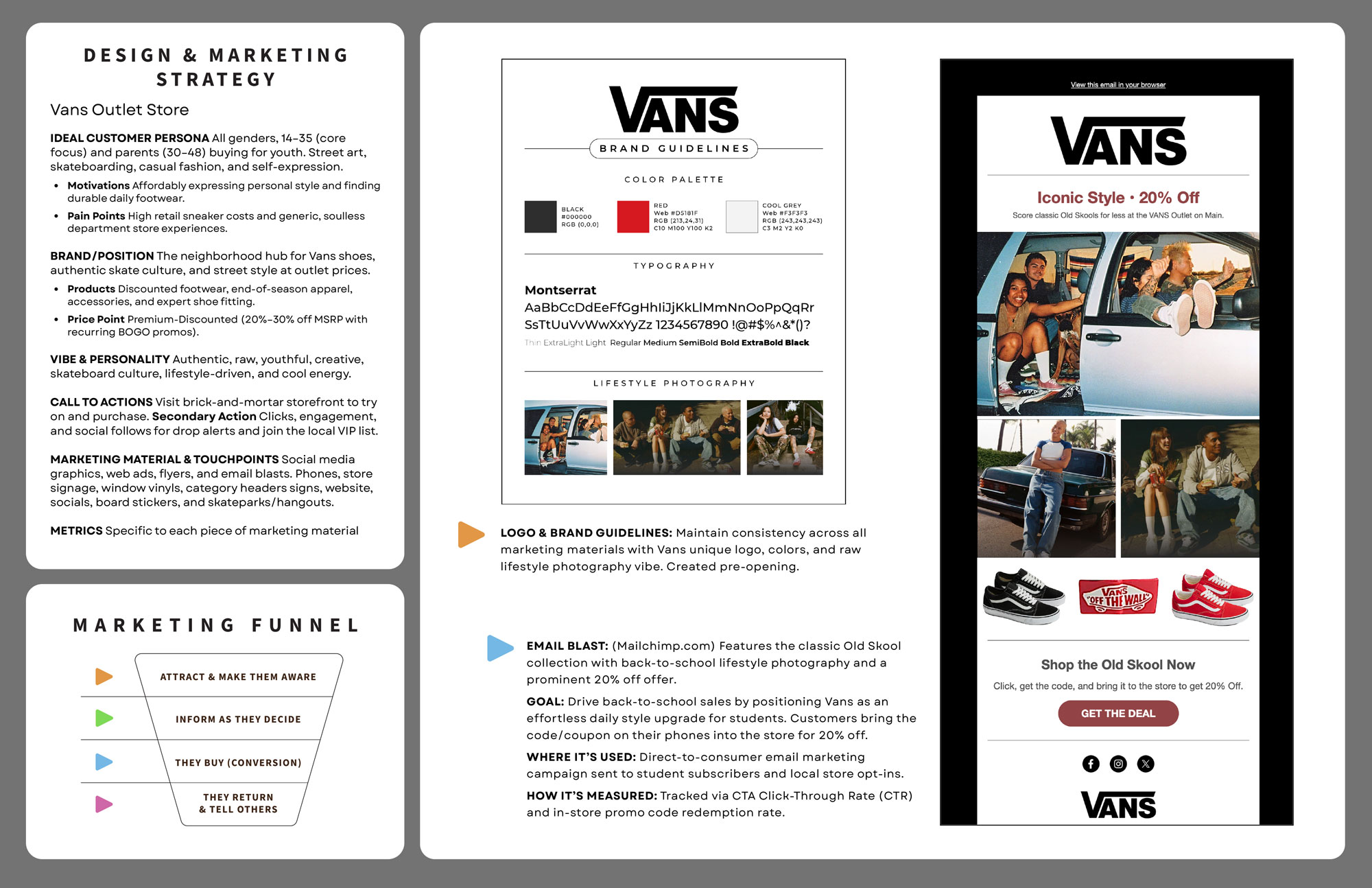
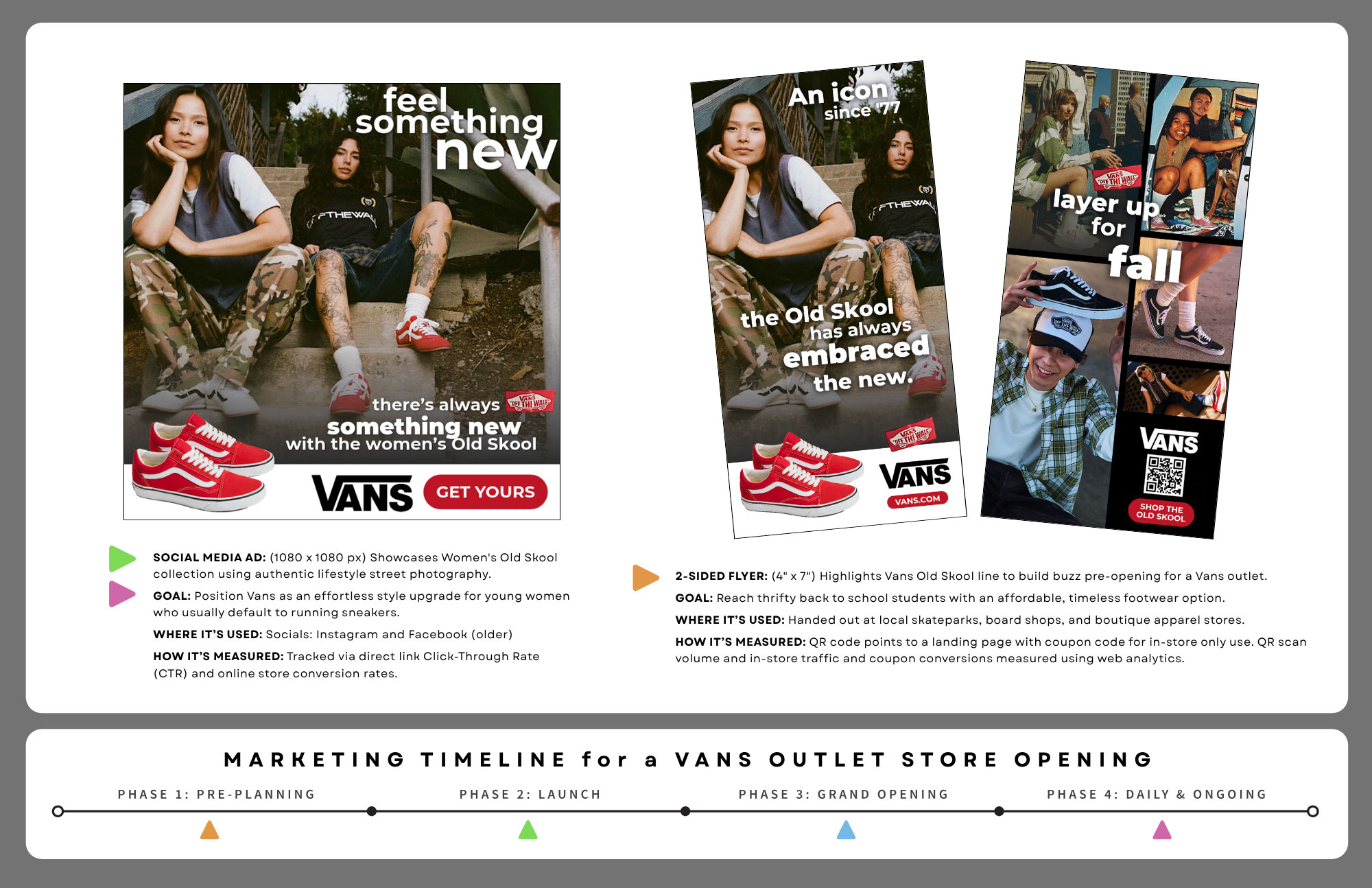
Here’s an example of how these five simple strategies are used in my Design Fundamentals class as students create and design a Marketing Campaign from the ground up. The VANS example below is meant to inspire students and give them a concrete sense of the project’s expectations while allowing them to retain some choice and flexibility.
Several guided steps and mini-projects combine to create a portfolio-quality, client-ready marketing campaign that helps them get their first job and demonstrate their in-depth understanding of the fusion of graphic design and marketing.
Five Research-Informed Strategies for Student Success
This tutorial explores how five research-based teaching and learning strategies can improve student learning, engagement, and success. Each strategy is presented in an accessible format and illustrated through its application in a real college graphic design project: the VANS Marketing Campaign.
The framework draws from established research in cognitive psychology, adult education, motivation, instructional design, and learning sciences. Rather than asking new instructors to become experts in educational theory, it translates these research findings into practical teaching approaches they can use in their own classrooms.
To see these five strategies applied to several graphic design classroom projects (in plain language), check out these links:
- VANS Shoes Marketing Campaign (Design Fundamentals class)
- Aurora Interior Designers Marketing Campaign (Digital Content Creation class)
- Windhill Studios Marketing Campaign (Web Design for Small Business class)
Why These Five Strategies?
Educational research consistently demonstrates that effective instruction involves more than delivering information. Students benefit from instruction that manages the demands placed on their working memory, connects learning to meaningful applications, provides appropriate guidance, accommodates differences among learners, and creates opportunities for active practice and feedback.
These five categories bring together complementary research-based approaches into one research-informed educational framework:
- Adult Learning & Motivation: Connect learning to real-world applications and support student motivation through choice, confidence, and meaningful goals.
- Cognitive Load & Effective Instruction: Make learning manageable by organizing information, reducing unnecessary complexity, and using effective visual and verbal instruction.
- Modeling, Scaffolding & Guided Practice: Demonstrate skills, provide structured support, and gradually develop student independence.
- Universal Design for Learning (UDL): Anticipate differences among learners and provide flexible ways to access information and demonstrate learning.
- Active Learning, Feedback & Reflection: Strengthen learning through practice, retrieval, constructive feedback, and self-assessment.
Together, these approaches provide a practical foundation for new technical college instructors, particularly those entering education with strong industry experience but limited formal training in instructional methods.
1. Adult Learning & Motivation
Make It Real & Keep Students Motivated
Connect lessons to real jobs and practical problems. Help students understand why they’re learning something and give them opportunities to make choices and experience success.
Academic Foundation
Adult Learning (Andragogy) was popularized in the United States by adult education scholar Malcolm Knowles during the 1960s and 1970s. His work emphasized the importance of relevant, practical, experience-based learning and involving students in their own learning.
Self-Determination Theory (SDT), developed by psychologists Edward Deci and Richard Ryan, adds an important understanding of student motivation. Their research identifies three basic psychological needs that support motivation and engagement:
- Autonomy: Having some choice and control over learning.
- Competence: Feeling capable of making progress and succeeding.
- Relatedness: Feeling connected to instructors, classmates, and the learning environment.
Together, these perspectives suggest that students are more likely to engage when learning feels relevant, they have some ownership of their work, and they believe they can succeed.
Read the Research:
- The Adult Learner – Malcolm Knowles, Elwood Holton, and Richard Swanson
- Self-Determination Theory and the Facilitation of Intrinsic Motivation, Social Development, and Well-Being – American Psychologist (2000)
- A Psychological Critique of Knowles’ Andragogy as a Theory of Learning (2024)
Note: Andragogy is a useful instructional framework, but it should not be treated as proof that adults and younger learners learn in fundamentally different ways. Practical relevance, autonomy, and meaningful learning experiences can benefit students of all ages.
What it means for teachers
- Career-focused students want to know why they’re learning something and how it applies to real jobs.
- Students are more engaged when they work on realistic problems instead of abstract assignments.
- Giving students choices and some control over their work can increase motivation.
- Small early successes build confidence and encourage students to keep improving.
How it is used in the VANS Marketing Campaign Project
- Real job tasks: Students act like working designers—writing a strategy, following brand rules, and connecting visuals to a marketing funnel and metrics.
- Job market proof: Instructions include real graphic design job postings showing that employers actually ask for these skills.
- Student choice: Students pick their own client and choose three marketing pieces to design.
- Portfolio-ready output: Every piece goes into a 2-page portfolio spread they can show during job interviews.
2. Cognitive Load & Effective Instruction
Don’t Overload Their Brains
Break big skills into smaller steps and pair clear visuals with simple instructions so beginners don’t get overwhelmed.
Academic Foundation
Cognitive Load Theory originated in cognitive psychology and is primarily associated with educational psychologist John Sweller. His foundational research showed that working memory has limited capacity and that complex instructional tasks can overwhelm beginners before they develop the knowledge and skills needed to manage them.
Research in this area supports breaking complex information into manageable pieces, providing appropriate examples, and gradually introducing more challenging tasks.
Richard Mayer’s Cognitive Theory of Multimedia Learning further explains how people process verbal and visual information. His research supports carefully combining words and relevant images to help learners understand complex material. However, multimedia instruction must be designed thoughtfully; adding more information or visuals does not automatically improve learning.
Read the Research:
- Cognitive Load During Problem Solving: Effects on Learning – Cognitive Science (1988), John Sweller
- Cognitive Theory of Multimedia Learning – The Cambridge Handbook of Multimedia Learning, Richard Mayer
- The Multimedia Principle – Cambridge Handbook of Multimedia Learning
What it means for teachers
- Beginners can only process a limited amount of new information at a time.
- Pairing simple text with clear, relevant visuals can help students understand new information.
- Showing a finished example before students start helps remove confusion.
- Build skills gradually rather than expecting students to master everything at once.
How it is used in the VANS Marketing Campaign Project
- Step-by-step chunking: The big campaign is broken into smaller pieces: strategy first, then brand guide, then three separate designs.
- Visual + text pairing: Every instruction page includes clear checklists alongside visual examples.
- Worked examples: Students see a complete sample campaign (the VANS Shoes example) and past student work before making their own.
- Beginner-friendly tools: Students can start in Canva instead of getting overwhelmed by advanced Adobe tools right away.
3. Modeling, Scaffolding & Guided Practice
Show Them How, Then Let Them Try
Show students how to do something, give them support while they practice, and gradually step back as their skills grow.
Academic Foundation
Cognitive Apprenticeship was developed by cognitive scientists Allan Collins, John Seely Brown, and Ann Holum. Their work draws from traditional apprenticeship models, where beginners learn by observing experienced professionals, practicing with guidance, and gradually taking responsibility for their own work.
The framework emphasizes several instructional methods, including modeling, coaching, scaffolding, articulation, reflection, and gradually reducing support as learners develop expertise.
This approach is particularly relevant to technical education, where students must develop practical skills and learn how experienced professionals make decisions.
The familiar classroom sequence of “I do, we do, you do” provides an accessible way to put these principles into practice.
Read the Research:
- Cognitive Apprenticeship: Making Thinking Visible – American Educator (1991), Collins, Brown & Holum
- Cognitive Apprenticeship – ERIC Education Resources
What it means for teachers
- Students learn hands-on skills by watching someone demonstrate the process.
- Explain not just what you’re doing, but why you’re making certain decisions.
- Give students examples, templates, and guidance when they’re starting out.
- Gradually reduce the support as students become more confident and independent.
How it is used in the VANS Marketing Campaign Project
- “I do” (Modeling): The instructor demonstrates how to build the pieces in class and provides short “How to use Canva” video walkthroughs.
- “We do” (Scaffolding): Students get downloadable assets, brand guideline templates, and a 2-page portfolio layout template so they don’t have to start from a blank screen.
- “You do” (Independent practice): Once students understand the basics, they choose their own marketing pieces and build a unique campaign on their own.
4. Universal Design for Learning (UDL)
Make Learning Accessible to Everyone
Build flexibility into your teaching by providing different ways for students to access information, learn new skills, participate, and demonstrate what they know.
Academic Foundation
Universal Design for Learning (UDL) developed from the broader universal design movement in architecture and product design. Its educational framework was pioneered by David Rose, Anne Meyer, and their colleagues at CAST (Center for Applied Special Technology) during the 1990s.
UDL recognizes that students bring different abilities, experiences, backgrounds, and learning needs into the classroom. Rather than designing instruction for an imagined average student and making accommodations only after someone struggles, UDL encourages instructors to anticipate potential learning barriers and build flexibility into instruction from the beginning.
The framework is organized around three principles:
- Multiple Means of Engagement: Provide different ways to motivate and involve students in learning.
- Multiple Means of Representation: Present information in different ways so students can access and understand it.
- Multiple Means of Action & Expression: Provide appropriate flexibility in how students practice and demonstrate their learning.
The current CAST Guidelines (Version 3.0, 2024) expand on these principles and emphasize reducing barriers and designing learning environments that support a wider range of learners.
Read the Research:
- Universal Design for Learning Guidelines 3.0 – CAST (2024)
- Universal Design for Learning: Theory and Practice – CAST
- CAST – About Universal Design for Learning
What it means for teachers
- Students don’t all learn, process information, or demonstrate understanding in the same way. One teaching approach won’t work equally well for everyone.
- If you primarily lecture, consider adding visual examples, short tutorial videos, demonstrations, or written instructions.
- If you demonstrate something in class, consider recording it so students can revisit the process when they need help or miss a step.
- Give students reasonable choices in how they approach assignments and demonstrate their skills while still meeting the same learning goals.
- Look at where students commonly struggle. Sometimes a new handout, video, example, checklist, or alternative explanation is all that’s needed.
- You don’t have to create everything at once. Start with one lesson or one learning barrier and gradually build helpful resources.
How it is used in the VANS Marketing Campaign Project
- Multiple ways to access instructions: Students can follow step-by-step written website instructions, view visual design examples, and watch video demonstrations to learn Canva workflows and layout techniques.
- Flexible learning pace: Video tutorials (like the “How to use Canva” walkthrough) allow students to pause, rewind, and review software steps independently at their own pace.
- Multiple ways to learn: The project combines live instructor demonstrations, hands-on practice, visual examples, and instructor feedback to support students with different learning needs.
- Flexible student expression: Students can choose their own client or brand, select which three marketing pieces to design (such as a flyer, web ad, or email), and decide whether to build their layouts in Canva or Adobe Illustrator to demonstrate their skills.
UDL: A Practical Approach to Adopting It
UDL doesn’t mean instructors must completely redesign their courses or create three different versions of every lesson. It means examining existing instruction and considering whether students have enough ways to access, understand, practice, and demonstrate what they’re learning.
Sometimes this will mean creating something new. If an instructor relies entirely on lectures, for example, adding a short tutorial video, a visual demonstration, or a written step-by-step handout could make a significant difference.
Traditional approach: I explain something to the class. Everyone receives the same explanation, in the same way, at the same time.
UDL approach: I explain and demonstrate something, but I also provide resources students can return to, different ways to understand the material, and reasonable flexibility in how they learn and demonstrate their skills.
For example:
| If you currently… | Consider adding… |
|---|---|
| Lecture about a topic | A visual presentation, short video, or reading handout |
| Demonstrate software in class | A recorded tutorial students can revisit |
| Give verbal assignment instructions | Written instructions and visual examples |
| Assign the same creative approach to everyone | Reasonable choices in project direction or format |
| Give students one opportunity to practice | Guided practice, examples, and opportunities to try again |
| Evaluate only the final product | Checkpoints, feedback, and opportunities to improve |
Remember: UDL doesn’t mean lowering expectations or allowing students to avoid learning essential skills. It means removing unnecessary barriers so more students have a reasonable opportunity to meet the same learning goals.
You don’t have to become a different kind of teacher. You just have to become a little more flexible in how you help students learn.
Improve what you’re already doing without feeling you need to build an entirely new course.
5. Active Learning, Formative Assessment & Solution-Focused Feedback
Keep Students Practicing, Improving & Moving Forward
Give students regular opportunities to apply what they’re learning, evaluate their progress, receive practical feedback, and make meaningful improvements.
Academic Foundation
Research on Active Learning demonstrates that students benefit from participating in meaningful learning activities rather than relying entirely on passive listening. Applying knowledge, solving problems, discussing ideas, and practicing skills help students become active participants in their own learning.
A major 2014 meta-analysis by Scott Freeman and colleagues examined 225 studies comparing traditional lecturing with active learning in undergraduate science, technology, engineering, and mathematics courses. The researchers found improved examination performance and lower failure rates in active-learning courses.
Formative Assessment research emphasizes the importance of checking student understanding throughout the learning process rather than relying only on final evaluations. This allows instructors and students to identify what is working, recognize areas that need attention, and make adjustments before the work is finished.
Feedback research further suggests that feedback is most useful when it helps students understand their current performance and identify specific actions they can take to improve. David Nicol and Debra Macfarlane-Dick’s work on formative assessment highlights the importance of helping students develop the ability to evaluate their own work and regulate their learning.
Together, these findings support a classroom approach where students regularly practice, receive useful feedback, evaluate their progress, and apply suggestions to improve their work. Feedback becomes part of the learning process rather than simply a judgment of the finished product.
Read the Research:
- Active Learning Increases Student Performance in Science, Engineering, and Mathematics – PNAS (2014), Freeman et al.
- Test-Enhanced Learning: Taking Memory Tests Improves Long-Term Retention – Psychological Science (2006), Roediger & Karpicke
- The Power of Testing Memory: Basic Research and Implications for Educational Practice – Perspectives on Psychological Science (2006)
- Formative Assessment and the Design of Instructional Systems – Nicol & Macfarlane-Dick (2006)
Note: The Freeman meta-analysis focused on undergraduate STEM courses, so its specific numerical findings should not be generalized directly to every technical college program. Retrieval practice research focuses specifically on memory and recall, while formative assessment research addresses feedback and improvement. Together, these bodies of research support different but complementary parts of this instructional approach.
What it means for teachers
- Students learn by actively applying what they’ve learned rather than only reading or listening.
- Regular progress checks help instructors identify where students need additional guidance.
- Useful feedback identifies what is working and offers practical suggestions for what to try next.
- Showing students possible solutions makes feedback easier to understand and apply.
- Checklists help students monitor their own progress and take responsibility for completing their work.
- Students need opportunities to practice, revise, and recognize how their work improves over time.
How it is used in the VANS Marketing Campaign Project
- Apply, don’t just read: Students apply marketing funnel concepts and metrics directly to their own designs and explain their decisions on their portfolio spread.
- Self-checklists: Every assignment page includes a clear grading checklist so students can inspect their own files, including size, format, and branding, before turning them in.
- Clear targets: The “4 Levels of Graded Design Work” shows students the difference between beginner work and client-ready work so they understand what they are working toward.
- Solution-focused feedback: Instructor critiques identify strengths and areas for improvement, then provide practical suggestions and possible design solutions. Students can use the written and visual feedback to decide what to try next.
- Progress and revision: Students have opportunities to apply feedback, revise their designs, and compare their earlier work with improved versions. This makes learning and progress visible.
- Critiques and presentations: Students participate in peer critiques and present their campaigns, explaining their strategy and design decisions. This encourages reflection, thoughtful evaluation, and learning from others.