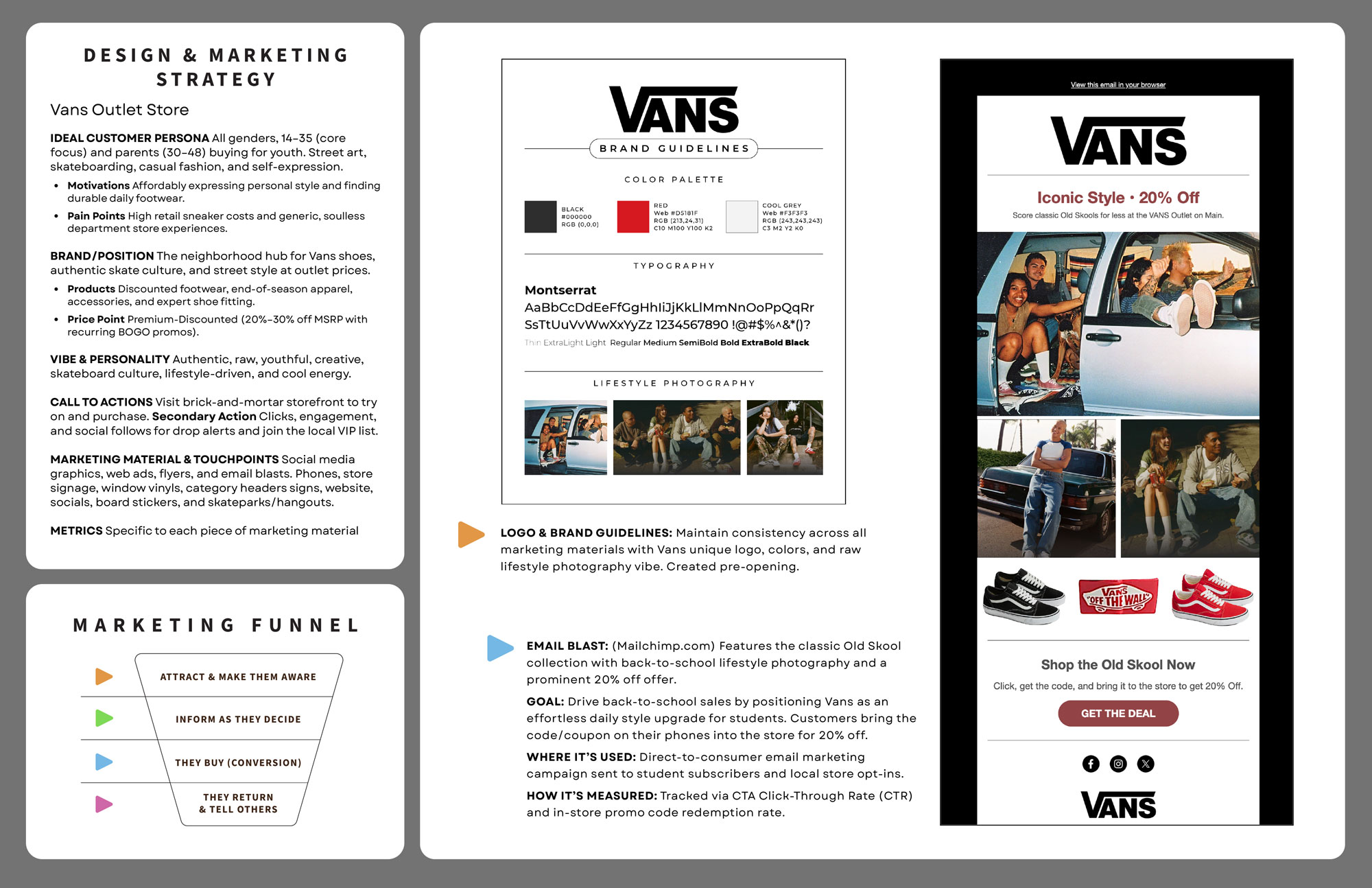
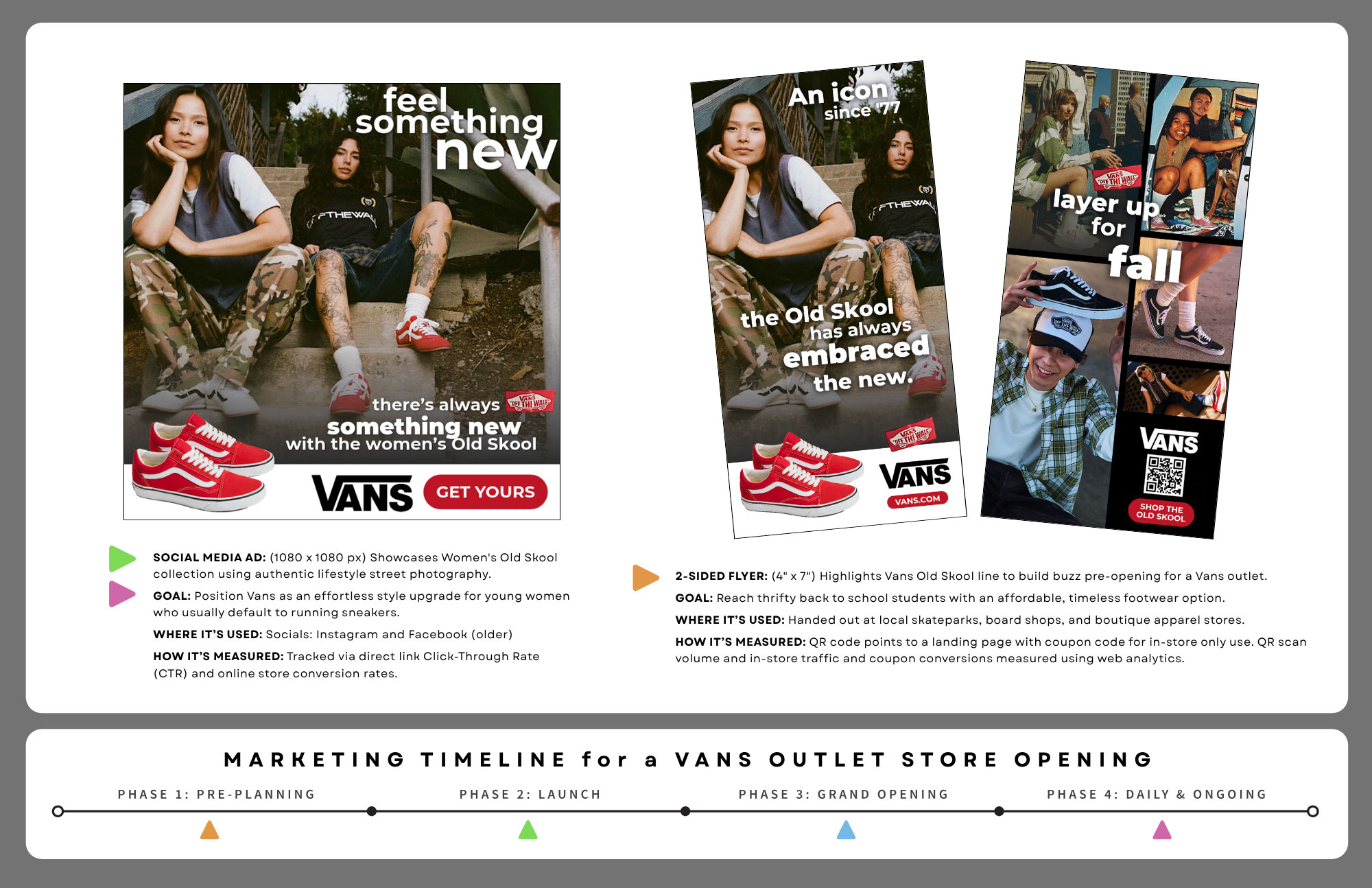
Here’s an example of how these five simple strategies are used in my Design Fundamentals class as students create and design a Marketing Campaign from the ground up. The VANS example below is meant to inspire students and give them a concrete sense of the project’s expectations (while retaining some choice and flexibility).
Several steps and mini-projects combine to create a portfolio-quality, client-ready marketing campaign that helps them get their first job and demonstrate their in-depth understanding of the fusion of graphic design and marketing.
1. Don’t Overload Their Brains
Break big skills into small steps and pair clear visuals with simple instructions so beginners don’t get overwhelmed.
What it means for teachers
- Beginners can hold only a few new things in their heads at a time.
- Pairing simple text with clear visuals helps students learn faster.
- Showing a finished example before they start removes confusion.
How it is used in the VANS Marketing Campaign Project
- Step-by-step chunking: The big campaign is broken into smaller pieces (strategy first, then brand guide, then three separate designs).
- Visual + text pairing: Every instruction page includes clear checklists alongside visual examples.
- Worked examples: Students see a complete sample campaign (the Vans Shoes example) and past student work before making their own.
- Beginner-friendly tools: Students can start in Canva instead of getting overwhelmed by advanced Adobe tools right away.
2. I Do, We Do, You Do
- Demonstrate how a pro does the work first (I do)
- Give students starter templates while they practice (we do)
- Slowly step back as their skills grow (you do).
What it means for teachers
- Students learn hands-on skills best when they watch an expert do the work first and hear why choices are made.
- Teachers give starter supports early on, then slowly step back as students gain skill.
How it is used in the VANS Marketing Campaign Project
- “I do” (Modeling): The instructor demonstrates how to build the pieces in class and provides short “How to use Canva” video walkthroughs.
- “We do” (Scaffolding): Students get downloadable assets, brand guideline templates, and a 2-page portfolio layout template so they don’t have to start from a blank screen.
- “You do” (Fading): Once students understand the basics, they choose their own marketing pieces and build a unique campaign on their own.
3. Make It Real
Connect every lesson to real jobs and practical problems so career-focused students immediately see why the work matters.
What it means for teachers
- Career-focused students try harder when they know why an assignment matters for a real job.
- They learn best by solving real-world problems instead of doing abstract busywork.
How it is used in the VANS Marketing Campaign Project
- Real job tasks: Students act like working designers—writing a strategy, following brand rules, and tying visuals to a marketing funnel and metrics.
- Job market proof: The instructions include real graphic design job postings to show employers actually ask for these exact skills.
- Portfolio-ready output: (Client-Ready) Every piece goes into a 2-page portfolio spread that students can show during job interviews.
4. Give Choice and Early Wins
Keep students motivated by giving them choices in their projects and setting up small, early successes that build their confidence.
What it means for teachers
- Students stay motivated when they have some control over their work.
- Early small successes build confidence and reduce fear of failure.
- Showing clear grading levels helps students see how to improve.
- Giving feedback that focuses on clear solutions and next steps keeps students motivated to improve instead of feeling stuck.
How it is used in the VANS Marketing Campaign Project
- Student choice: Students pick their own client and choose three marketing pieces to design.
- Early wins: Using Canva templates and clear design rules (like “one main message” and “one large photo”) helps beginners make a clean, professional ad quickly.
- Clear targets: The “4 Levels of Graded Design Work” shows students the difference between beginner work and “client-ready” work so they know what to aim for.
- Actionable feedback: Critiques focus on practical solutions and clear next steps, helping students stay motivated to improve their designs.
5. Make Learning Stick
Help students remember what they learn by having them actively apply concepts and use checklists to inspect their own work.
What it means for teachers
- Students remember more when they have to recall and apply ideas repeatedly.
- Teaching students to check their own work turns them into independent problem-solvers.
How it is used in the VANS Marketing Campaign Project
- Apply, don’t just read: Students don’t take a test on the marketing funnel or metrics—they have to apply them directly to their own designs and explain their choices on their portfolio spread.
- Self-checklists: Every assignment page includes a clear grading checklist so students can inspect their own files (size, format, branding) before turning them in.
- Critiques and presentations: Presenting their campaign and explaining their strategy out loud forces students to think through why their design works.
A Deeper, More Academic Dive
This tutorial shows how these six simple classroom strategies can enhance learning by showing how they are applied to a real college graphic design project.
- Cognitive Load Theory
- Cognitive Apprenticeship (“I do, we do, you do”)
- Andragogy & Applied Adult Learning
- Self-Determination Theory
- Retrieval Practice & Self-Monitoring
- UDL – Universal Design for Learning
Educational researchers increasingly recommend pairing broad accessibility frameworks—such as Universal Design for Learning (UDL)—with concrete, evidence-based cognitive and motivational strategies, while actively retiring popular neuromyths like “learning styles.” While UDL establishes an essential foundation for inclusive access, postsecondary research shows that its broad guidelines are often applied inconsistently unless instructors are also trained in specific, step-by-step instructional mechanics (Toward an Inclusive Pedagogy Through Universal Design for Learning, ERIC).
At the same time, decades of cognitive psychology have repeatedly refuted the “meshing hypothesis” of learning styles—proving that tailoring lessons to a student’s self-reported visual, auditory, or kinesthetic preference does not improve learning outcomes (Learning Styles: Concepts and Evidence, Psychological Science in the Public Interest,
Stop Propagating the Learning Styles Myth, Computers & Education).
Instead, researchers advise training faculty in dual coding and multimodal instruction—combining concise verbal explanations with clear visual demonstrations for all learners regardless of preference (Cognitive Theory of Multimedia Learning, Cambridge University Press)—alongside practical, cognitive-science-backed teaching routines (Principles of Instruction: Research-Based Strategies That All Teachers Should Know, American Educator).
This shift is especially critical for new technical college faculty transitioning directly from industry into the classroom, who bring deep trade expertise but often lack formal pedagogical training on how to scaffold complex, hands-on skills for diverse adult and young-adult learners (From Practice to Pedagogy: Examining the Learning Process of Industry Professionals Becoming Technical College Instructors, University of Georgia Research Repository).
Consequently, focusing year-one faculty development on these five evidence-based categories gives new instructors the highest return on investment in student engagement, skill retention, and classroom success.
1. Cognitive Load Theory
Don’t Overload Their Brains: Break big skills into small steps and pair clear visuals with simple instructions so beginners don’t get overwhelmed.
Academic Foundation: Cognitive Load Theory originated in the late 1980s from cognitive psychology and human memory research at the University of New South Wales in Australia, and is primarily credited to educational psychologist John Sweller. His research demonstrated that human working memory has a strictly limited capacity, meaning instructional materials that are overly complex or poorly structured actually block beginners from storing new skills in long-term memory.
—Read the Research: Cognitive Load During Problem Solving: Effects on Learning (Cognitive Science, 1988)
What it means for teachers
- Beginners can hold only a few new things in their heads at a time.
- Pairing simple text with clear visuals helps students learn faster.
- Showing a finished example before they start removes confusion.
How it is used in the VANS Marketing Campaign Project
- Step-by-step chunking: The big campaign is broken into smaller pieces (strategy first, then brand guide, then three separate designs).
- Visual + text pairing: Every instruction page includes clear checklists alongside visual examples.
- Worked examples: Students see a complete sample campaign (the Vans Shoes example) and past student work before making their own.
- Beginner-friendly tools: Students can start in Canva instead of getting overwhelmed by advanced Adobe tools right away.
2. Cognitive Apprenticeship (“I Do, We Do, You Do”)
Show, Guide, Then Let Go:
1. Demonstrate how a pro does the work first (I do)
2. Give students starter templates while they practice (we do)
3. Slowly step back as their skills grow (you do).
Academic Foundation: Cognitive Apprenticeship was developed in the late 1980s by cognitive scientists Allan Collins, John Seely Brown, and Susan Newman (working out of Xerox PARC and Bolt, Beranek and Newman). Originating from studies of situated learning and traditional craft apprenticeships, the framework translates how master tradespeople train novices into a structured classroom method for teaching complex thinking and technical skills—often summarized in classrooms as the Gradual Release of Responsibility (“I do, we do, you do”).
—Read the Research: Cognitive Apprenticeship: Making Thinking Visible (American Educator, 1991)
What it means for teachers
- Students learn hands-on skills best when they watch an expert do the work first and hear why choices are made.
- Teachers give starter supports early on, then slowly step back as students gain skill.
How it is used in the VANS Marketing Campaign Project
- “I do” (Modeling): The instructor demonstrates how to build the pieces in class and provides short “How to use Canva” video walkthroughs.
- “We do” (Scaffolding): Students get downloadable assets, brand guideline templates, and a 2-page portfolio layout template so they don’t have to start from a blank screen.
- “You do” (Fading): Once students understand the basics, they choose their own marketing pieces and build a unique campaign on their own.
3. Andragogy & Applied Adult Learning
Make It Real: Connect every lesson to real jobs and practical problems so career-focused students immediately see why the work matters.
Andragogy: Helping adults learn
Pedagogy: Helping children learn
Academic Foundation: Andragogy was popularized in the United States in the late 1960s and 1970s by adult education scholar Malcolm Knowles (building on earlier European adult education theory). Originating from research on how adults and career-focused learners differ from children, the theory holds that older, workforce-bound students learn best when instruction is self-directed, draws on real-world experience, and immediately solves practical problems.
—Read the Research: An Examination of Knowles’ Model of Andragogy (Irish Journal of Academic Practice / ERIC, 2009)
What it means for teachers
- Career-focused students try harder when they know why an assignment matters for a real job.
- They learn best by solving real-world problems instead of doing abstract busywork.
How it is used in the VANS Marketing Campaign Project
- Real job tasks: Students act like working designers—writing a strategy, following brand rules, and tying visuals to a marketing funnel and metrics.
- Job market proof: The instructions include real graphic design job postings to show employers actually ask for these exact skills.
- Portfolio-ready output: (Client-Ready) Every piece goes into a 2-page portfolio spread that students can show during job interviews.
4. Self-Determination Theory
Give Choice and Early Wins: Keep students motivated by giving them choices in their projects and setting up small, early successes that build their confidence.
Academic Foundation: Self-Determination Theory originated in the 1980s from empirical motivation research conducted by psychologists Edward Deci and Richard Ryan at the University of Rochester. Their work proved that intrinsic student motivation and persistence depend on classrooms satisfying three core psychological needs: autonomy (choice and control), competence (feeling capable of success), and relatedness (connection to peers and real-world goals).
—Read the Research: Self-Determination Theory and the Facilitation of Intrinsic Motivation, Social Development, and Well-Being (American Psychologist, 2000)
What it means for teachers
- Students stay motivated when they have some control over their work.
- Early small successes build confidence and reduce fear of failure.
- Showing clear grading levels helps students see how to improve.
- Giving feedback that focuses on clear solutions and next steps keeps students motivated to improve instead of feeling stuck.
How it is used in the VANS Marketing Campaign Project
- Student choice: Students pick their own client and choose three marketing pieces to design.
- Early wins: Using Canva templates and clear design rules (like “one main message” and “one large photo”) helps beginners make a clean, professional ad quickly.
- Clear targets: The “4 Levels of Graded Design Work” shows students the difference between beginner work and “client-ready” work so they know what to aim for.
- Actionable feedback: Critiques focus on practical solutions and clear next steps, helping students stay motivated to improve their designs.
5. Retrieval Practice & Self-Monitoring
Make Learning Stick: Help students remember what they learn by having them actively apply concepts and use checklists to inspect their own work.
Academic Foundation: Retrieval Practice (often called the “testing effect”) originates from cognitive psychology research on long-term memory retention, spearheaded in modern educational settings by Henry L. Roediger III and Jeffrey D. Karpicke at Washington University in St. Louis. Their research shows that actively recalling and applying knowledge—rather than passively re-reading notes or watching tutorials—dramatically strengthens long-term mastery and helps learners accurately judge what they know.
—Read the Research: Test-Enhanced Learning: Taking Memory Tests Improves Long-Term Retention (Psychological Science / PubMed, 2006)
What it means for teachers
- Students remember more when they have to recall and apply ideas repeatedly.
- Teaching students to check their own work turns them into independent problem-solvers.
How it is used in the Marketing Campaign Project
- Apply, don’t just read: Students don’t take a test on the marketing funnel or metrics—they have to apply them directly to their own designs and explain their choices on their portfolio spread.
- Self-checklists: Every assignment page includes a clear grading checklist so students can inspect their own files (size, format, branding) before turning them in.
- Critiques and presentations: Presenting their campaign and explaining their strategy out loud forces students to think through why their design works.
UDL doesn’t mean instructors must completely redesign their courses or create three different versions of every lesson. But it does mean they should look at how they currently teach and consider whether they are providing enough ways for students to access, understand, practice, and demonstrate what they’re learning.
Sometimes that will mean creating something new. If an instructor relies entirely on lectures, for example, adding a short tutorial video, a visual demonstration, or a written step-by-step handout could make a significant difference.
I’d expand your sixth strategy to make that expectation clearer.
6. Make Learning Accessible to Everyone
(Universal Design for Learning – UDL)
Build flexibility into your teaching by providing different ways for students to access information, learn new skills, participate, and demonstrate what they know. Look at your existing lessons and add resources or teaching approaches where they could help remove learning barriers.
What it means for teachers
- Students don’t all learn, process information, or demonstrate understanding in the same way. One teaching approach won’t work equally well for everyone.
- If you primarily lecture, consider adding visual examples, short tutorial videos, demonstrations, or written instructions so students have other ways to understand the material.
- If you demonstrate something in class, consider recording it so students can revisit the process when they need help or miss a step.
- Give students reasonable choices in how they approach assignments, practice skills, or demonstrate their understanding while still meeting the same learning goals.
- Look at your existing lessons and identify where students commonly struggle. Sometimes a new handout, video, example, checklist, or alternative explanation is all that’s needed to make learning easier.
- You don’t have to create everything at once. Start with one lesson or one learning barrier and gradually build a collection of helpful resources.
How it is used in the Digital Content Creation Marketing Campaign Project
- Multiple ways to access instructions: Students can follow written, step-by-step website instructions, view visual examples, and watch video demonstrations to learn camera techniques and editing workflows.
- Flexible learning pace: Recorded demonstrations let students pause, rewind, and revisit techniques at their own pace rather than relying entirely on live classroom demonstrations.
- Multiple ways to learn: The course combines instructor demonstrations, hands-on practice, visual examples, guided exercises, and individual assistance to support students with different learning needs.
- Flexible student expression: Students select their own client or brand focus and can choose the types of photos, videos, and marketing content they create to demonstrate their skills.
UDL – A Practical Approach to Adopting It
Traditional approach: I explain something to the class. Everyone receives the same explanation, in the same way, at the same time.
UDL approach: I explain and demonstrate something, but I also provide resources students can return to, different ways to understand the material, and reasonable flexibility in how they learn and demonstrate their skills.
For Example
| If you currently… | Consider adding… |
|---|---|
| Lecture about a topic | A visual presentation, short video, or reading handout |
| Demonstrate software in class | A recorded tutorial students can revisit |
| Give verbal assignment instructions | Written instructions and visual examples |
| Assign the same creative approach to everyone | Reasonable choices in project direction or format |
| Give students one opportunity to practice | Guided practice, examples, and opportunities to try again |
| Evaluate only the final product | Checkpoints, feedback, and opportunities to improve |
Remember
- UDL doesn’t mean lowering expectations or allowing students to avoid learning essential skills. It means removing unnecessary barriers so more students have a reasonable opportunity to meet the same learning goals.
- You don’t have to become a different kind of teacher. You just have to become a little more flexible in how you help students learn.
- Improve what you’re already doing without feeling you need to build an entirely new course.