
A Community of Practice for NFE Teachers at Western Technical College
Purpose
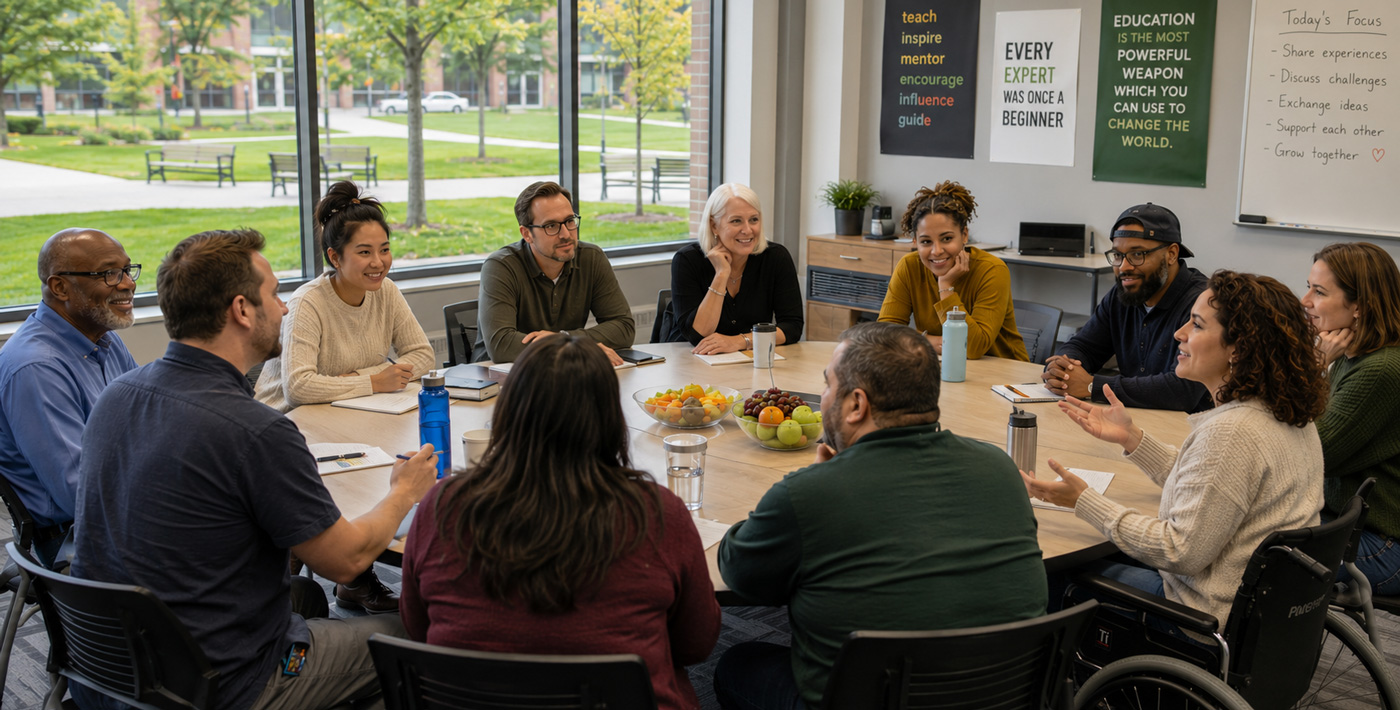
A welcoming, cross-disciplinary community where new faculty from the New Faculty Experience come together once a month to discuss real teaching challenges, exchange ideas, and learn from one another’s experiences. There are no presentations, evaluations, or “right answers”—just thoughtful conversations that build confidence, improve teaching, and strengthen our community.
Invite
You’re invited to join a monthly, one-hour conversation with faculty colleagues who have problems in their classrooms they would like help fixing. These teachers share a passion for teaching, learning, and student success. This is a supportive, judgment-free space to discuss real classroom challenges, exchange practical ideas, and learn from one another’s experiences. Each session centers on group-chosen authentic conversations about teaching and learning—not presentations or lectures. Together we’ll reflect, problem-solve, and grow as educators while building connections across programs and divisions. Come with a question, a challenge, a success story—or simply a willingness to listen and help.
Suggested Format
- Welcome Everyone (5 min)
- Name and program
- Follow up on last month’s topic (10 min)
- Optional Sharing: Which suggestions worked and which didn’t?
- We Choose Our Topic (5 min):
- “What’s on your mind this month?”
- Each person briefly shares one challenge, question, or situation (30–60 seconds each).
- List all the ideas.
- The group decides by consensus which one would benefit the most people.
- Teaching Conversation (30 min)
- No advice yet—First, clarify the situation. Any questions about the topic?
- Share your experiences. What has worked? What didn’t?
- Explore possibilities.
- Brainstorm practical ideas. What’s worth trying?
- There is no pressure to solve the problem perfectly.
- Takeaways and Next Steps (5–10 min)
- What’s one idea you might try before our next meeting?
No homework, no evaluation, no required follow-up, just an invitation to come back next month.
Share Our Work on a Web Page
We’ll publish a brief synopsis of our work and our helpful teaching and learning tips on a web page for all to view, review, and share.
Suggested Guidelines
- Be positive.
- Everyone has something to contribute.
- Listen to understand, and ask questions as needed, before offering advice.
- Share your experiences, and limit “evidence-based” prescriptions or fixes.
- Allow everyone to talk and share.
- Confidentiality builds trust.
- Leave with one idea to try.
Initial Discussion Topics – If needed to get started
- What’s one teaching practice you’ve changed that made a noticeable difference?
- What does your ideal classroom learning environment look, sound, and feel like?
- Have students ever asked you to change something about your class? What?
- Currently, what frustrates you the most about your teaching?
- What are you doing when you see students genuinely engaged?
- What are you doing when you see students stop participating?
- How do you give feedback that students actually use?
- How do you manage AI while still promoting learning?
- How can you build stronger relationships with students while maintaining high expectations?
- How do you help struggling students without lowering standards?
- How do you design assignments that truly measure learning?
- How do you balance teaching, grading, and everything else?
Successful Communities of Practice consistently include
- Regular meetings over time (not one-time workshops)
- Cross-disciplinary participation
- Real classroom problems
- Reflection and dialogue
- Voluntary participation
- Psychological safety
- Practical ideas participants can use immediately
These elements are associated with increased instructional confidence, greater adoption of evidence-based teaching practices, stronger professional networks, and a culture of continuous improvement. (ScienceDirect)
A blend of three evidence-based approaches
- Communities of Practice (Wenger) – learning through shared experience.
- Faculty Learning Communities (Milton Cox) – sustained, small-group faculty development.
- Effective Professional Development (Darling-Hammond et al.) – collaborative, job-embedded, reflective learning.
Research suggests that ongoing, conversation-based communities produce more lasting changes in teaching than one-time workshops because they build trust, reflection, and a willingness to experiment with new practices.
Resources
Foundational Theory
- Wenger, E. (1998). Communities of Practice: Learning, Meaning, and Identity.
- Lave, J., & Wenger, E. (1991). Situated Learning: Legitimate Peripheral Participation.
Higher Education Research
- Communities of Practice in the Higher Education Landscape: A Literature Review (Online Learning Consortium, 2023) – Excellent synthesis and practical guidance.
- Do Communities of Practice Enhance Faculty Development? (Systematic Review, 2016) – Reviews 24 studies and concludes that CoPs improve teaching practice through shared knowledge, reflection, and professional relationships.
- Using Communities of Practice to Foster Faculty Development in Higher Education (McMaster University, 2011) – Describes successful cross-disciplinary Communities of Practice focused on pedagogy, teaching with technology, and first-year instructors.
- How Can a Faculty Community of Practice Change Classroom Practices? (2019) – Faculty met for six to eight one-hour sessions over multiple semesters. Peer discussion and classroom observation led participants to adopt new teaching strategies.
- Communities of Teaching Practice in the Workplace (2015) – Found that coaching, reflection, and peer support increased teaching confidence and contributed to a stronger culture of teaching.
My ideas — slightly buffed out through numerous conversations with AI (Gemini and ChatGPT).
ChatGPT helped me find the listed resources in order to challenge my thoughts and ideas.