
Quick links to design principles on this page:
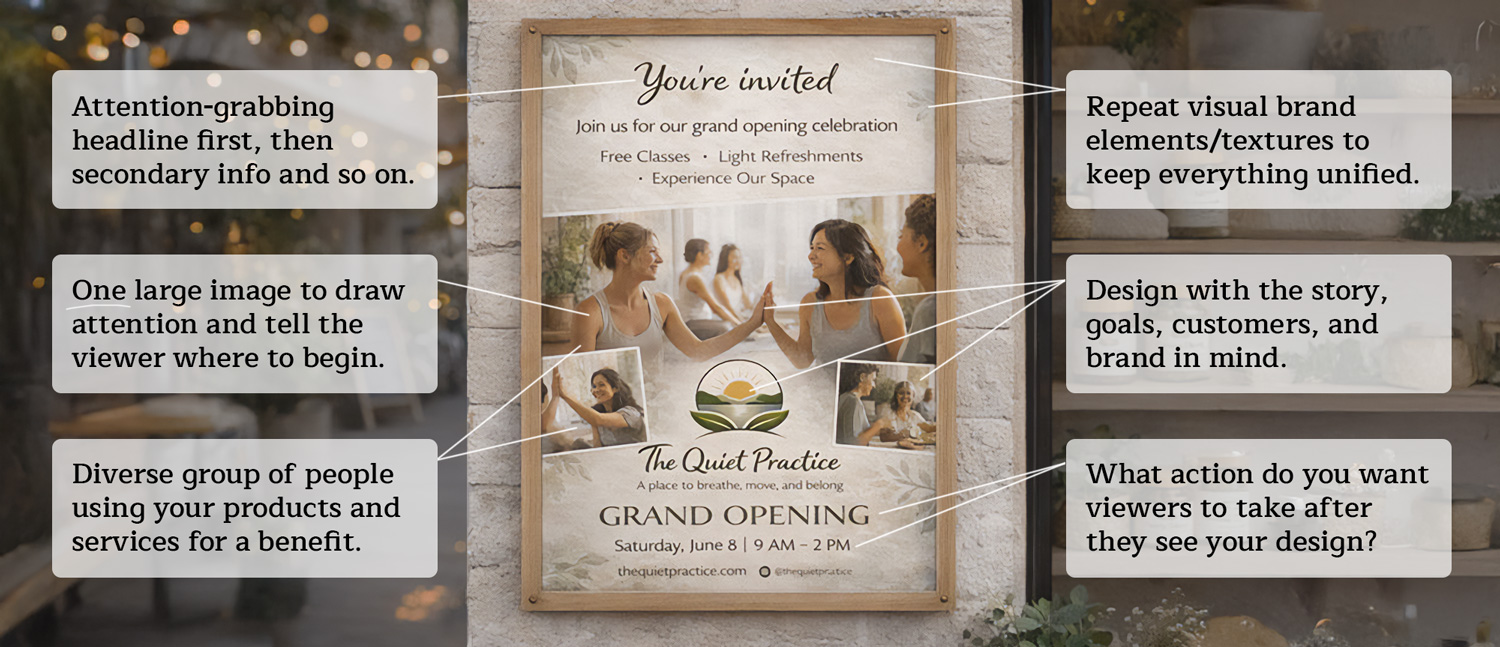
Six Simple Design Basics to Always Follow
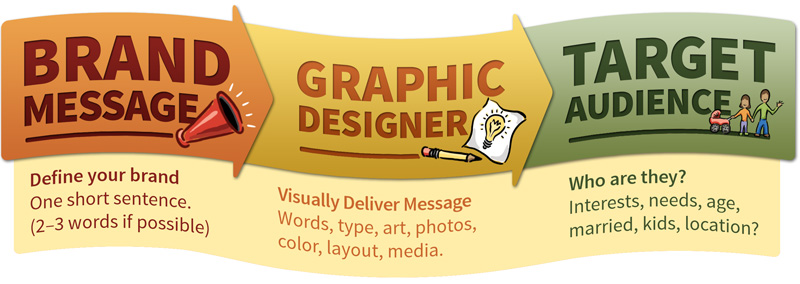
Message
Brand Message
The brand message is consistent and usually never changes.
The brand message is simply: what people think about when they think of your company.
Subway’s brand message is “Eat Fresh.” What do you think about when you think of Subway? Fresh sub sandwiches? Eat Fresh? Kids meals? All are correct answers, depending on your opinions of Subway. But the main message Subway wants to communicate is “Eat Fresh.”
The others, kids club, new bread flavors, breakfast, seasonal sandwiches, etc., are all marketing campaigns that will change. Eat Fresh is the primary brand message—it must not change. If it does, Subway will begin to lose its brand recognition among customers and, ultimately, its brand loyalty. That’s usually the end of a business. If a business’s brand isn’t serving its customers most of the time, it will rebrand itself entirely. Charter Communications is a good example. Customers associated them with poor customer service and an out-of-date company as we changed from cable TV to internet streaming. So, they re-branded as Spectrum—leaving behind their damaged Charter brand.
Here’s an example of a defined brand message for a local ice cream parlor that has a kids’ playground:
- Position / What makes you different?: We aren’t just a dessert spot; we are a “Mini-Vacation for Parents.” While other shops focus on the cone, we focus on the experience by providing a controlled, high-energy environment where kids can be loud and play while parents relax.
- Products / Services: Small-batch “Wacky Flavors” (e.g., Cereal Milk, Glitter Pop), birthday party hosting, and “Meet the Mascot” weekend events.
- Price Point: Mid-to-High. People pay a premium for the convenience of the play area and the entertainment value.
- Personality / Vibe: Whimsical, energetic, safe, and slightly chaotic (in a fun way!). Think “Bright Colors & High Energy.”
- Why designers care: This dictates the Visual Identity. If the vibe is “high energy,” a designer shouldn’t use muted, minimalist “artisan” beige. They need to use high-contrast colors and rounded, friendly typography that signals “Kids welcome here!”
A Visual Storyteller
As a visual designer, your job is to understand the marketing message (story) that is to be delivered to the audience. You put that message into a visual form:
Marketing Campaigns
The consistent brand directs each different marketing campaign.
Marketing campaigns can change, and often do, to target specific markets. The marketing campaign can be, and often is, the company’s brand.
Again, Subway uses several different marketing campaigns to reach different target markets—Jared’s weight loss, kids club, new bread flavors, new sandwich choices, new menu items, breakfast, seasonal sandwiches, etc.
What types of messages do companies and organizations communicate?
Most businesses and organizations communicate or “sell” one of four things:
- Products
These are tangible products we can touch and feel, such as food, toys, tools, radios, computers, cars, cosmetics, books, and furniture. - Services.
These are usually intangible things that we purchase, like health care, financial advice, website hosting, cable television, phone service, an auto mechanic’s knowledge, education, home cleaning services, a caterer serving food at your wedding, etc. - Ideas / Ideals
Or sometimes ideals. These are usually intangible things like ideas promised by a politician, or a new concept taught by a teacher, or a new theory marketed by a researcher to prove themselves worthy of government or private funding. - A combination of product, service, and idea
This includes many of the items listed in 1, 2, and 3. When you hire a wedding photographer, you buy their service (their knowledge, training, and expertise as a photographer) and their product (usually printed wedding photos). A college professor may have a new idea they want to sell, but they can only tell a limited number of students face-to-face. So they put their ideas on the Web in an eBook or a printed book and sell it as a product.
Strong brands “own” a short message in our hearts and minds
What do you want people to think about when they see your client’s new logo, icon, direct mail piece, packaging, website, or advertisement? When customers think of strong brands, they usually think of short phrases or single words.
The stronger and clearer the brand, the more focused the message (brand) is in the minds of consumers. Your brand words should be a benefit that your customers will want.
Here are strong brands and the words people associate with them:
- YouTube – Video Streaming
- HGTV – DIY and home-improvement TV
- Food Network – Cooking shows
- Instagram – Photo-sharing social network
- Tesla – Luxury electric cars
- Patreon – YouTube, but you actually get paid
- Etsy – Handmade goods for sale
- eBay – Online auction site
- Barnes & Noble – Bookseller
- Patagonia – Outdoor outfitter
- FedEx – overnight shipping
- Taco Bell – Mexican fast food
- Nike – high-performance athletic shoes
- Subway – eat fresh, and freshly made sub sandwiches
- Tide – clean clothes
- X-games – extreme sports games
- Krispy Kreme donuts – tasty glazed donuts
- Starbucks – gourmet, high-end coffee
- Coke – cola (especially in the South)
- Mercedes – a luxury car
- Porsche – luxury sports car
- Red Bull – energy drink
- Timex – value-priced, durable watches
- Hershey’s – chocolate candy bar
Audience
“Audience” is my simple yet effective way to say, “Please define your primary demographic target audience.” That sounds a bit “stuffy” to my students, and to me—so audience seems to work well.
Who does your client want to reach with their brand and/or campaign message? You must know who you are “speaking” to before you can design something for them.
Mountain Dew targets young people who lead fast, active lifestyles. The design of Mountain Dew’s logo, packaging, advertising, and commercials “speaks” to their young, active target market. Everything designers and marketers do is based on speaking to these Mountain Dew drinkers and connecting them with their lively, green beverage.
You should learn as much as possible about your target market and begin to understand their lifestyles. How do you do this? The best way is to engage with them and ask them frequently.
Here’s an example of an Ideal Customer Persona for a local ice cream parlor that has a kids’ playground:
Ideal Customer Persona: “Hectic Heather”
- Demographics: Female, 30–42, suburban homeowner.
- Lifestyle/Hobbies: Juggling school runs, soccer practice, and remote work. Values “Core Memories” and seeks out “Instagrammable” moments with her kids.
- Pain Points: Standard cafes are too quiet (she feels judged if her kid yells); park outings are weather-dependent; she’s exhausted and needs a “win” for the day.
- Motivations: Keeping the kids entertained so she can have 15 minutes of peace or a meaningful conversation with a friend.
- Why designers care: Designers need to design for empathy. If Heather is stressed and distracted, the menu board shouldn’t be a wall of tiny text. It needs to be highly legible with clear hierarchy so she can order quickly while holding a toddler’s hand.
Other things to consider when defining your audience
- How does your audience feel about your product, service, or idea? What beliefs do they hold regarding it?
- How does your audience use your product, service, or idea?
- How often do they use your product, service, or idea?
- Where do they live? (state, country, weather, landscape, etc.)
- Female? Male? Other?
- Married? Single? Divorced? Kids?
- Pets? (dogs, cats, fish, horses, reptiles, hamsters, ferrets, hobby farm, etc.)
- Education?
- Age?
- Strongly held beliefs? (religious, political, human rights, freedom, environment, etc.)
- Passionate about? (environment, education, feed the hungry, gun ownership, causes, advocacies, etc.)
- Hobbies & Interests? (hunting, HAM radio, sewing, ceramics, boating, running, skiing, family time, etc.)
- What generation is the majority of your target market?
- Gen Alpha
- Gen Z
- Millennials
- Gen X
- Baby Boomers
- Silent Generation (Traditionalists, Veterans)
- Where does your audience get most of their information? (Internet, cable news, print, network news / phone, tablet, computer, radio, TV, word-of-mouth)
Design Style
Design style is pretty simple. Your design style (type, art, photos, video, colors, design elements, and layout) must help deliver your message to your audience. All your design decisions will be directed by the message and audience.
Here are a few examples:
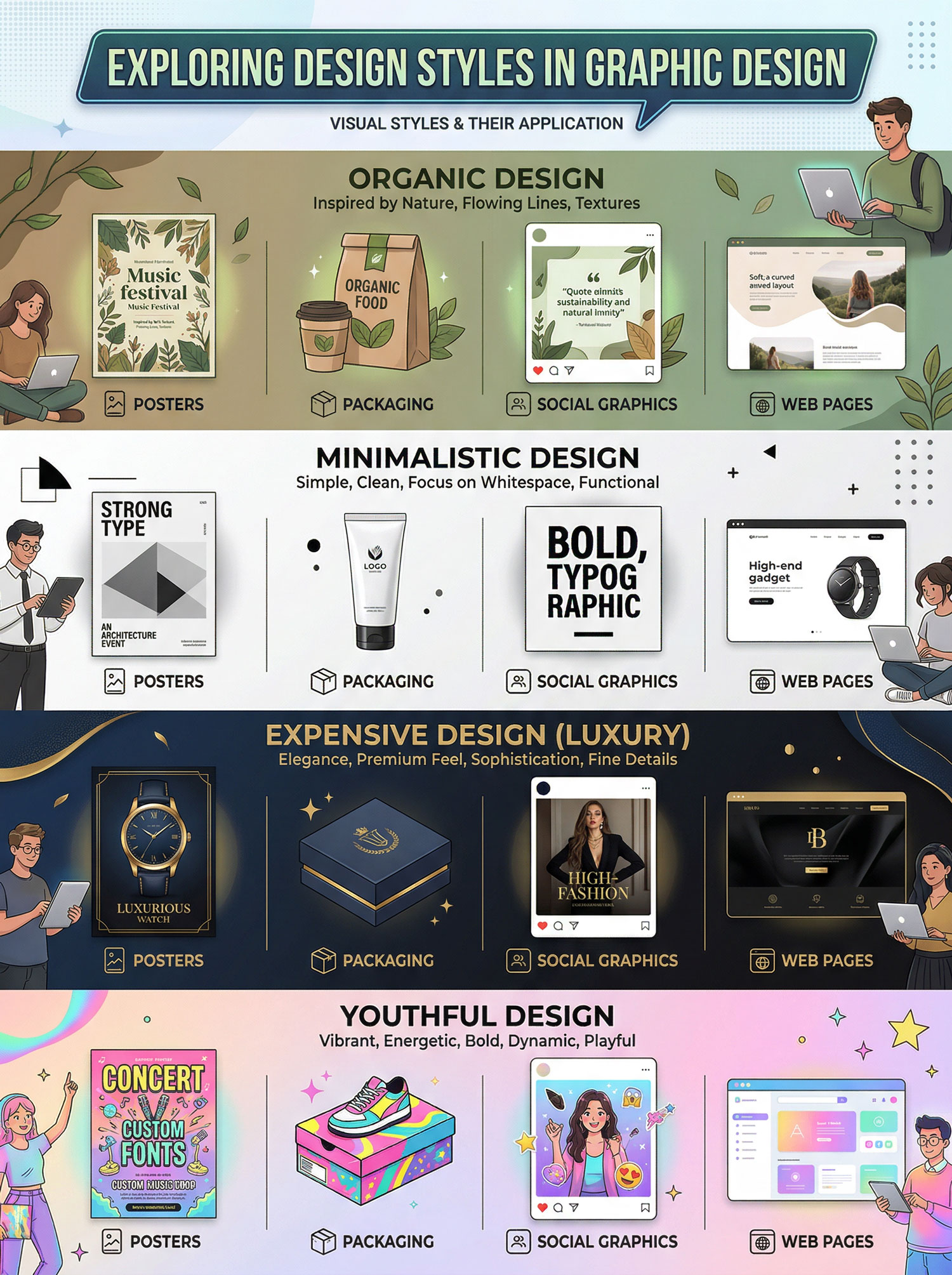
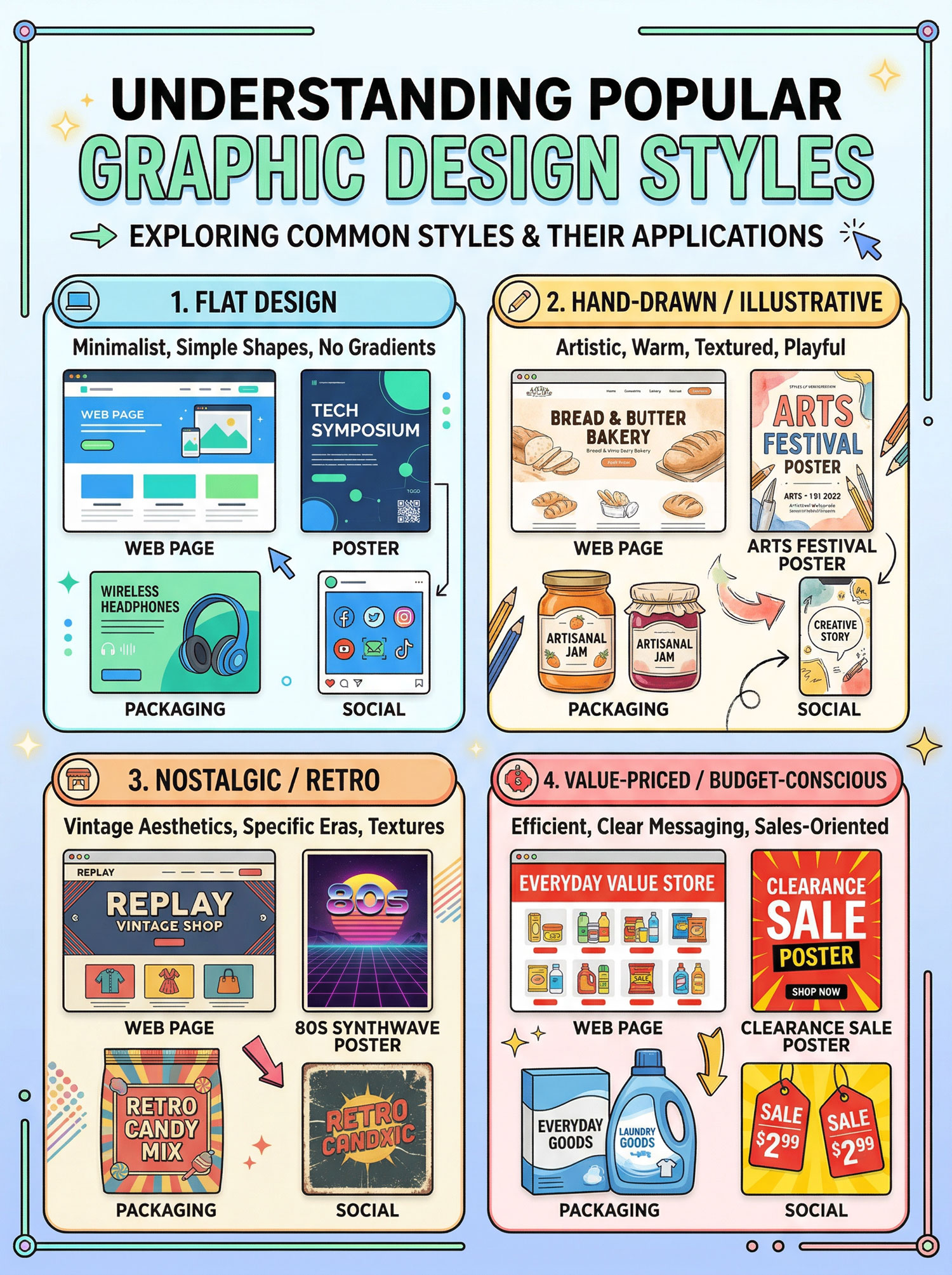
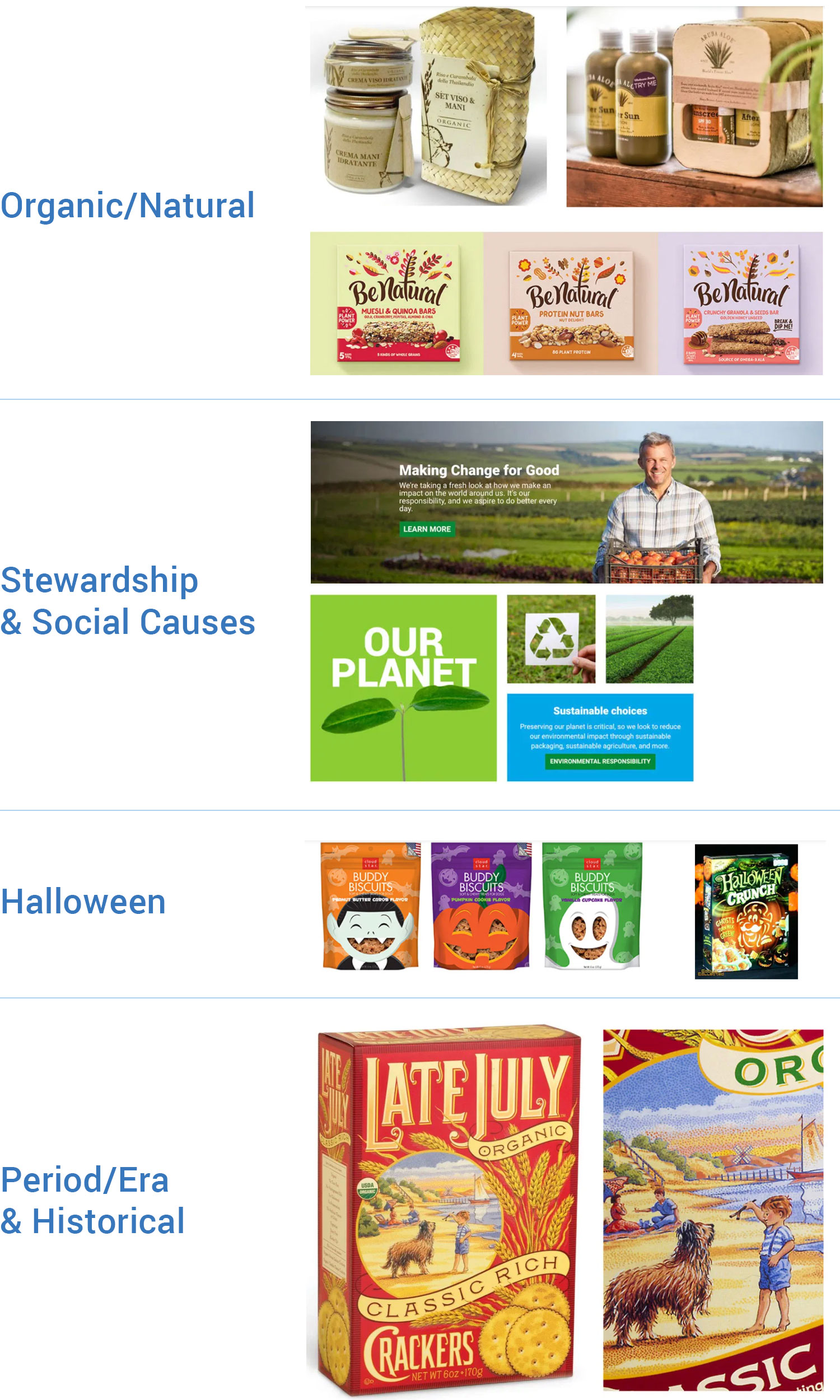
Your client’s brand and/or marketing campaign directs the design style. What will your message look like? Everything you design fits the brand and marketing campaign—the typefaces, art, photography, colors, patterns, layouts, borders, etc. The design style focuses on appropriateness. Meaning, is the design style appropriate to deliver the brand or marketing campaign’s message to the target market?
Examples: If you really like drawing anime, and your client sells anime comic books, your design style will be a good fit. However, some designers can’t break away from their own passions and will design a website for a drive-in hamburger restaurant using their beloved anime style—a horrible idea and a poor fit for their client.
We must be flexible as designers and think of our clients’ needs. All seasoned graphic designers have the ability to design in many different styles, and they have an inventory of skills to serve their client’s needs—not just their own artistic needs.
Remember that a graphic designer works for someone else (the client). It is important to design for their needs. message and target market (customers).
Call-To-Action
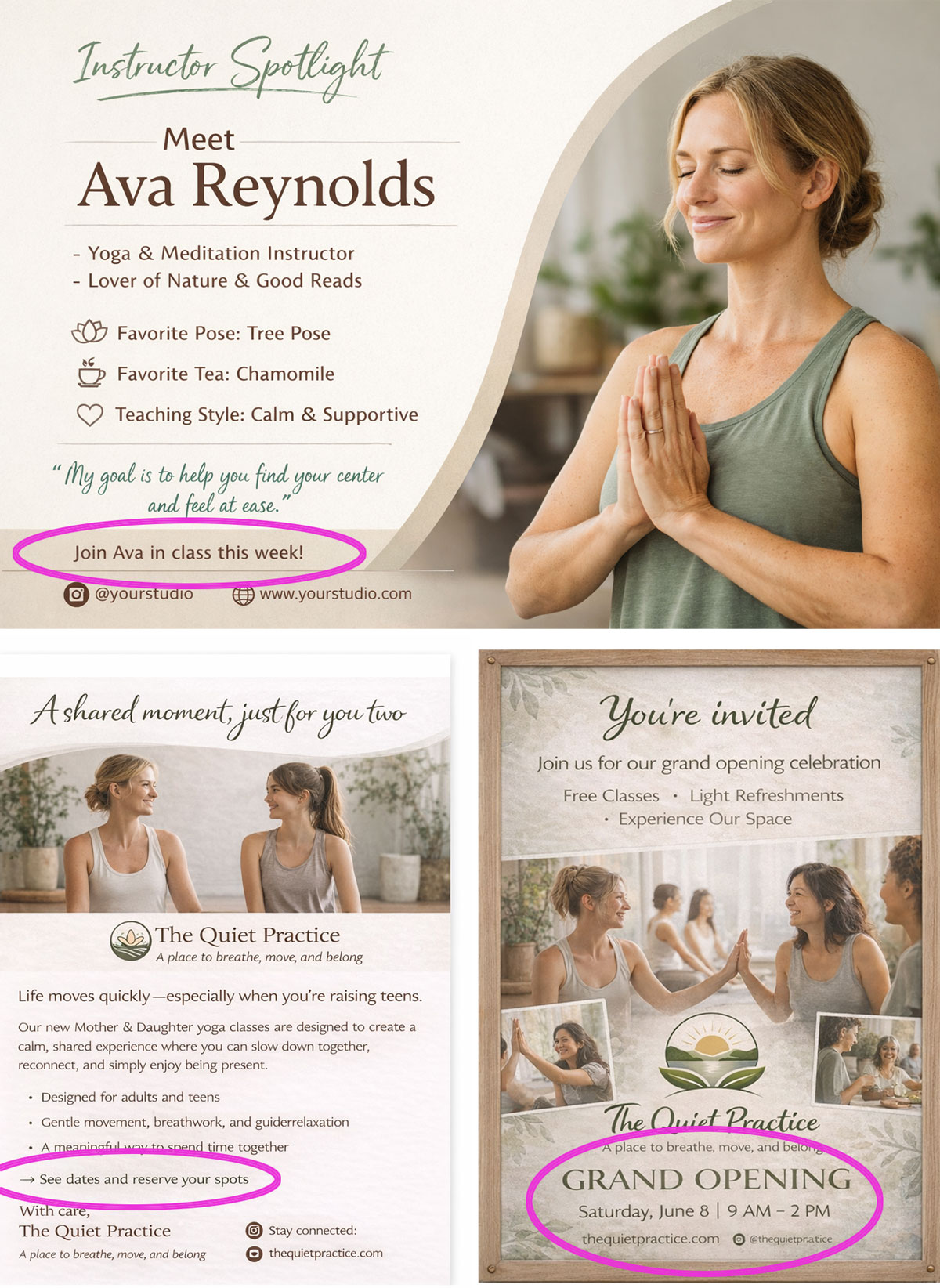
A call to action is an important component of any piece of marketing material. Once your viewer is done reading and viewing your message, you want to set them into action and try to move them down the marketing funnel.
A great Call-to-Action (CTA) is the bridge between a customer just looking and actually doing. Whether it’s a glossy magazine ad or a smartphone notification, the goal is to make the next step feel like a no-brainer.
Remember, your design work is trying to:
- Ease a pain point for a customer
- Solve a problem for your client
- Deliver a message to an audience
Here are several different forms a CTA can take:
- The Direct Lead Tells customers exactly what to do next, like “Buy Now” or “Sign Up Today.”
- The Curiosity Gap Uses phrases like “Learn More” to entice readers who want the full story.
- The Limited-Time Offer Creates urgency by mentioning a deadline, making people act before they miss out.
- The Freebie Hook Offers something for nothing, like a “Download Free Guide” to build initial trust.
- The Social Proof Encourages joining a community, such as “Join 10,000 Happy Members” to feel included.
- The Low-Stakes Entry Reduces pressure with phrases like “Start Your Trial” so users feel safe trying.
- The Problem Solver Focuses on the benefit, like “Get Better Sleep Now” to address a specific pain.
- The Interactive Choice Asks a question or offers a quiz to get the customer personally involved.
- The Physical Direction Common in print, using “Visit Us In-Store” to drive real-world foot traffic.
- The Scannable Shortcut Uses QR codes in print to bridge the gap between paper and digital.
- The Personalized Invite Uses “My” instead of “Your,” like “Start My Journey,” to make it feel custom.
- The Service Connector Simple buttons like “Call Now” or “Book Appointment” for immediate, one-on-one human contact.