Over the past several years, I’ve seen graphic design job openings on Indeed.com increasingly require more marketing knowledge and skills.
Percentage of graphic design job postings (researched by students) asking for marketing skills:
- 2022: 45%
- 2026: 56%
Here are my initial thoughts on how we, as a team, can integrate more marketing principles into our design curriculum. Just thoughts and ideas, we’ll discuss all this as a team.
As AI evolves and takes over some rote, simple, and basic graphic design tasks, the opportunity arises to shift our focus to the new graphic designer who thinks more critically and holistically embraces the “why” of design. In addition to creating beautiful, creative design work, students will increasingly lean into the marketing and UI/UX side of design that is more user- and customer-focused. Students will still learn to be strong and effective designers, they will still get hands-on experience designing real-world marketing material, they will still learn the leading industry software, but they will also learn more about integrating marketing strategies and consumer personas into their design work, cutting-edge skills like AI integration, UI/UX, app and website prototyping, motion graphics, 3D graphics, and eventually video editing and how to design for XR/VR/AR.
As you’ll see below, our classes won’t really change; we will still pick our own class projects, and some of my “asks” are simply realigning what we are already doing well. I feel the project realignments (below) will really simplify how marketing fits into graphic design and help our students understand the fusion.
1. We finalize our new program description
Thinking about what we already do well and what the future holds, I wrote a new program description, along with AI, to capture and promote our current successes and our evolving strategy. I’d like this to be a starting point for this evolution, and we can work together to refine it and craft our future. I am embracing this approach in my classes, especially having students lean into the “why” through marketing strategies when they design.
I wrote this new description to speak to Gen Z and the upcoming Generation Alpha in a snappy, student-focused, professional tone.
• NEW Program Description – Proposal •
Graphic Design – Associate of Applied Science
Design Tomorrow. Build Your Career. Make an Impact.
Are you ready to turn your creative mindset into a rewarding career? Our Graphic Design AAS blends cutting-edge skills with real-world experience to prepare you for the evolving design landscape. This program isn’t just about learning tools — it’s about developing thinking designers who understand the “why” behind every choice and can solve real problems through powerful visual communication.
You’ll leave with a portfolio that proves you can design for the real world — featuring hands-on projects like social media campaigns, digital ads, websites, UI/UX experiences, motion graphics, branding systems, packaging, signage, and print marketing materials. (future: 3D Design, VR/AR, Website, and App prototyping and design.)
What Makes Us Different
In today’s competitive landscape, basic design skills aren’t enough. Employers want designers who think strategically, design with purpose, and create work that engages audiences on screen and in space. That’s why our program goes beyond traditional curriculum by:
- Focusing on Design Thinking & the “Why” of Design: You’ll learn how to approach problems with strategy, in addition to aesthetics — so your solutions are functional, meaningful, and impactful.
- Integrating AI: You’ll learn how to integrate AI into the designer’s workflow to improve research capabilities, creativity, productivity, and efficiency.
- Marketing-Integrated Thinking: Understand how design works within branding and marketing strategies so your work connects with audiences and drives results.
- Real-World Projects & Portfolio Ready Work: From client campaigns to collaborative team briefs, you’ll build a professional portfolio that shows future employers what you can do.
- User-Centered UI/UX & Interactive Design: You’ll learn to create intuitive and engaging digital experiences — from apps to responsive web interfaces — grounded in user research and experience principles.
- Next-Gen Visual Skills: Dive into motion graphics, app and web prototyping, 3D design, and immersive media like AR/VR/XR, giving you the tools and confidence to explore emerging creative roles in the digital age.
What You’ll Learn
Throughout this 2–3 year Associate of Applied Science program, you’ll develop:
- Strong foundations in typography, layout, color, and composition
- Proficiency in industry-standard software (Adobe Creative Cloud + more)
- How to integrate AI into the designer’s workflow
- UI/UX design fundamentals and user-research methods
- Motion graphics and animation principles
- 3D visualization and immersive media workflows
- Real-world project planning, client collaboration, and presentation skills
- Strategic integration of design within marketing and communication campaigns
Your Future in Design Starts Here
Whether you want to work at a creative agency, in-house with brands, or launch your own freelance career, our Graphic Design program equips you with the skills employers want. From traditional visual communication to cutting-edge interactive experiences, you’ll graduate ready to make an immediate impact — backed by a portfolio that tells your design story.
Design with purpose. Innovate with confidence. Start your journey here.
2. We update our program learning outcomes
- Apply the principles of design and marketing to develop strategic marketing and communication products and
services. - Communicate artwork rationale in formal and informal settings
- Demonstrate proficiency in the use of design software, tools, and technology.
- Implement creative solutions from concept through completion using a formal process.
- Apply effective legal and ethical business practices and project management skills.
3. We backward design from our signature assessment, an ideal two-page graduate portfolio spread.
(FYI: This signature assessment is already backward designed from our Program Learning Outcomes)
To really show employers that our students understand the fusion of graphic design and marketing principles, I would like our ideal graduate portfolio 2-page spread to look like the pages below.
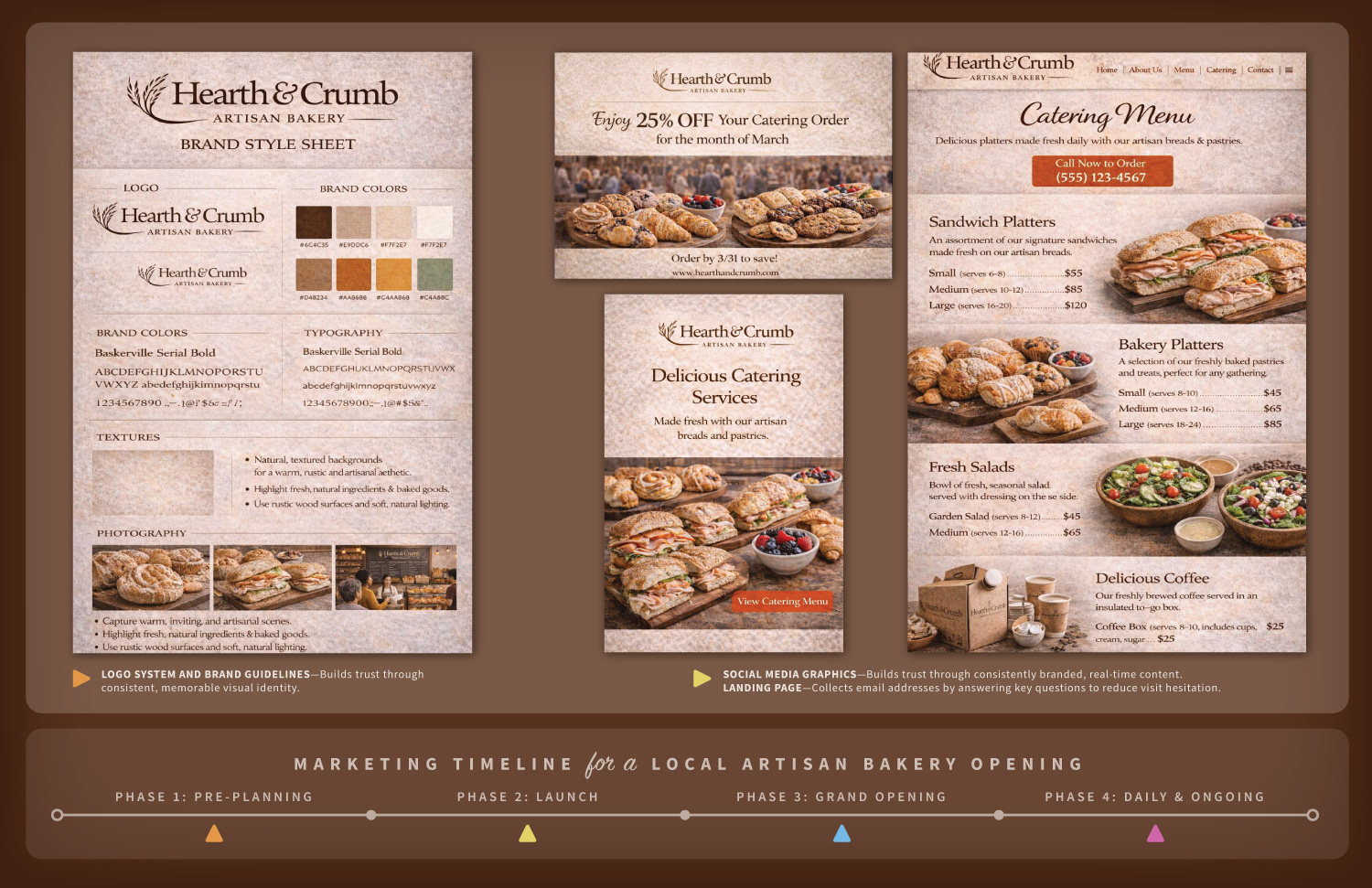
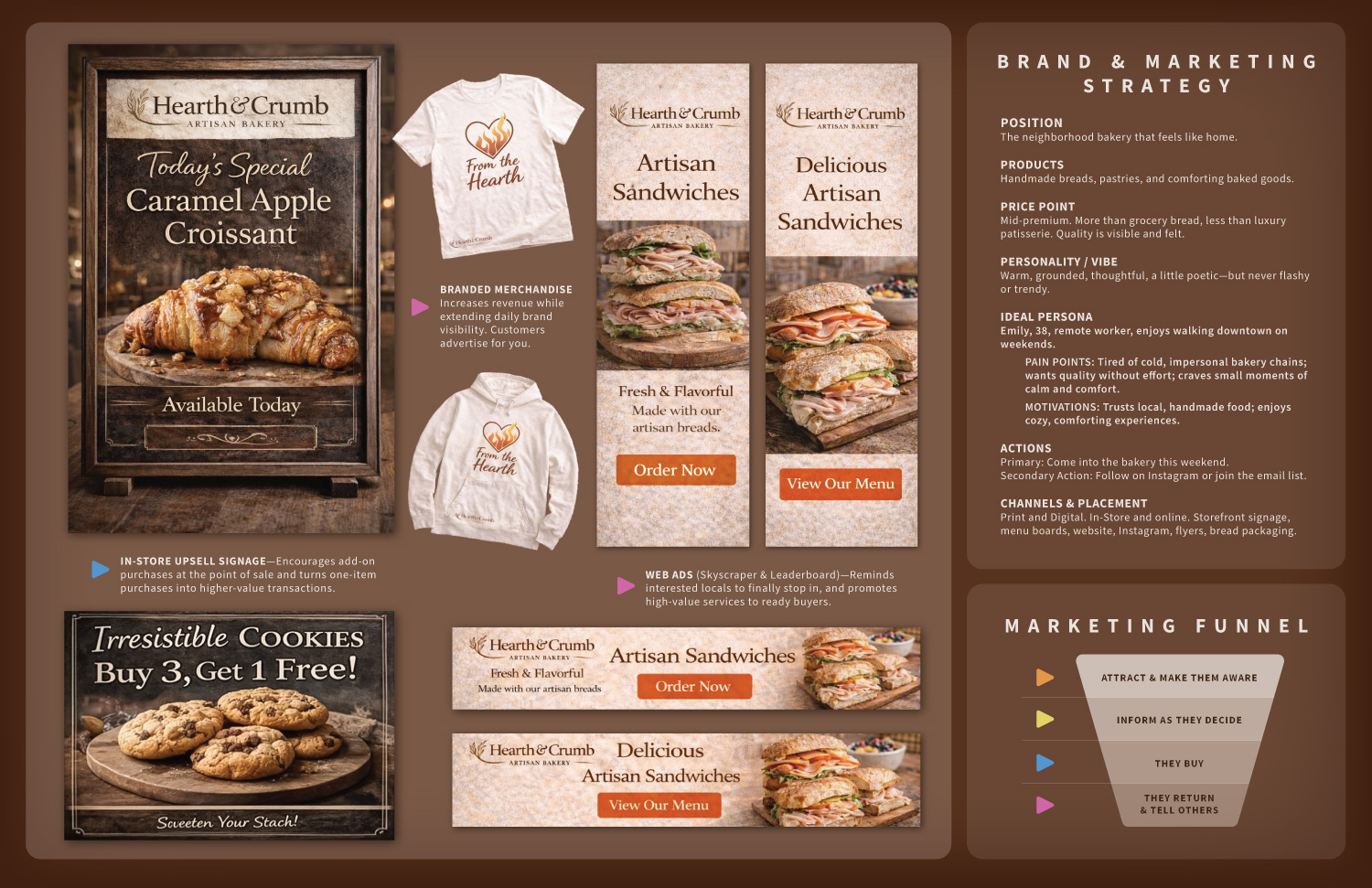
I’m showing my plan through the lens of marketing a local artisan bakery opening in a town like La Crosse.
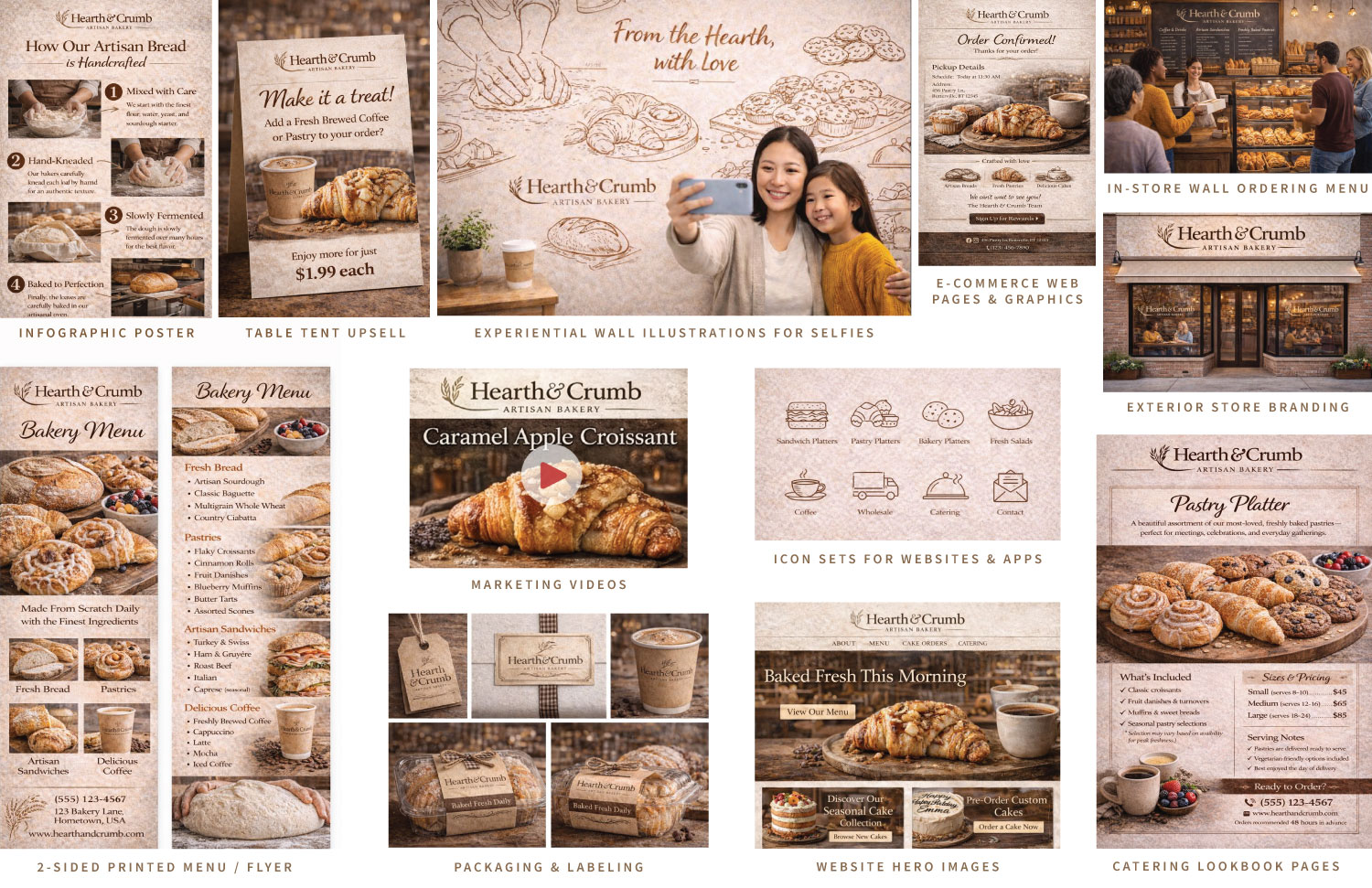
The page above shows the many types of marketing materials students can design for a marketing campaign. We already teach these in most classes. I would just ask that you consider tying them into one of the five marketing campaigns students will build as they progress through the program (more about that below).
As you can see from the examples above, there is something for every class:
- Lookbook pages for Pub 1 or 2 to make for print and/or digital iPad viewing
- Illustrated experiential wall design for Photoshop or Illustrator
- Lots of compositing projects within the posters, flyers, and menus for Photoshop
- Illustrated icon sets for Illustrator or Photoshop
- Websites and landing pages for Website Design 1 or 2
- Word art design for screenprinting in Designing with Type
- Marketing videos for Intro to Motion Graphics, Graphic Design & Marketing, and the new Photography & Video Production class (more about this class below)
- Lots of social and web graphics and web ads for all classes
4. A simple approach for fusing design and marketing for students
I’d like students to follow the opening and ongoing marketing timeline of a business or organization as a catalyst for learning how to fuse design and marketing. I’ve used the opening of Hearth & Crumb, a locally owned artisan bakery, as my example to you, and I’ll use it for students.
Students would research and gain a deeper understanding of how their design work fits within the business’s wider marketing strategy. Pages like these will help students better understand this integration:
As well as following the process below in class:

I will offer to introduce this entire concept to students as they begin our program in Design Fundamentals. I’d introduce the strategy and ask them to pick two clients to begin. I’d also introduce them to the marketing strategy knowledge needed to get started. Then, they would begin designing a few pieces for each client.
5. Changing 2 classes in our curriculum and adding a 1-year option
As I think about our employer needs, how our program should evolve, how AI impacts us, how we could add more web and app prototyping, more 3D design, and more VR/AR, I’d like to suggest two class changes (below).
With this model, VR/AR will still take place, with or without the grant. But the main focus, no matter what new technology or software we add going forward, will be graduating lean, mean designers who understand and can demonstrate how marketing strategy, consumer personas, and branding drive their work.
Again, I know our advisory committee’s response to our previous curriculum changes last fall was lukewarm, but I think they would respond positively to this approach, and we would still get to do everything that has been suggested over the last year.
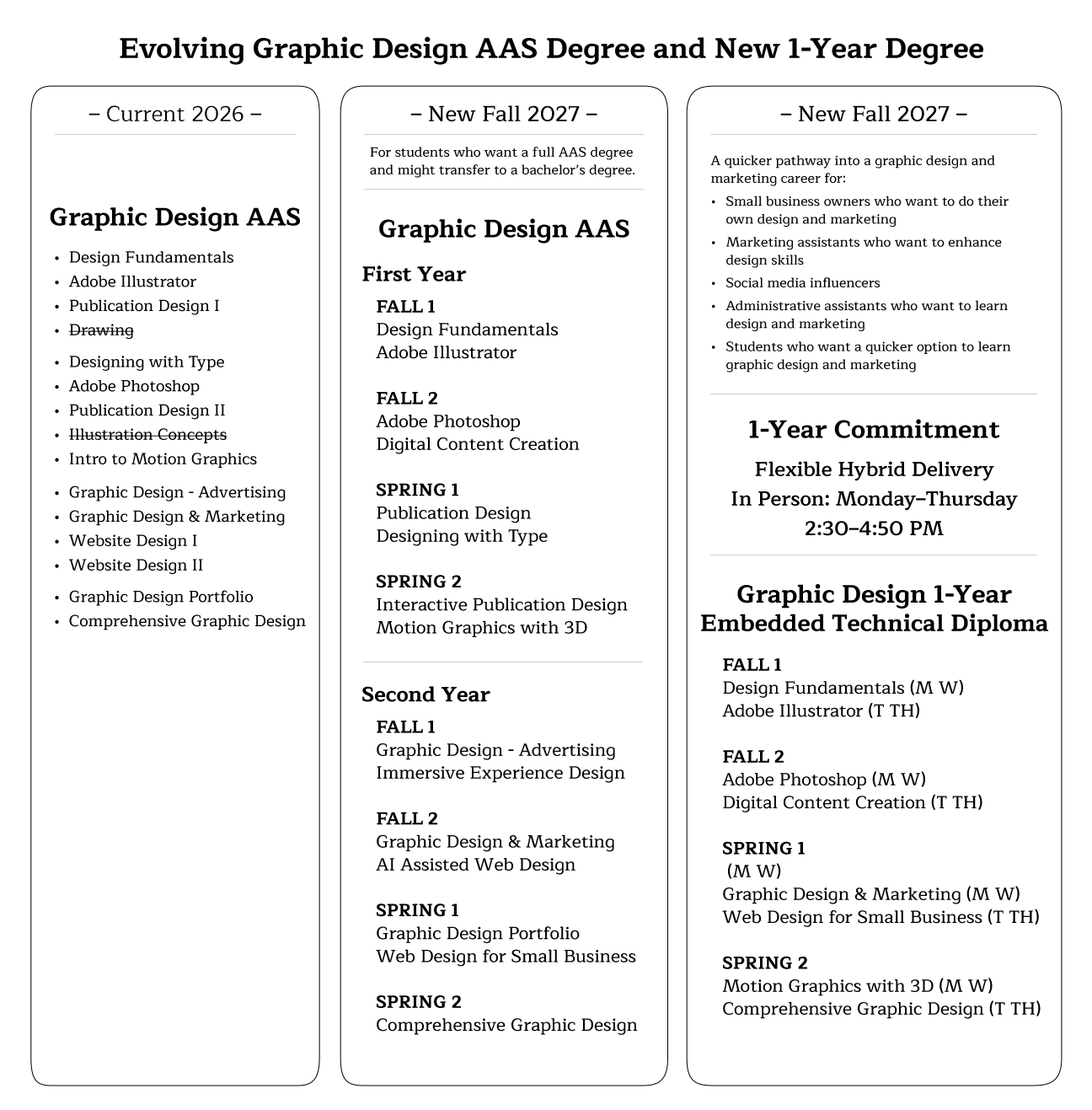
A few notes:
- Foundational drawing skills and sketching for ideation could be rolled into Design Fundamentals, Illustrator, Photoshop, and Pub 1.
- Illustration Concepts digital/vector drawing skills could be rolled into Photoshop and Illustrator.
- The 1-year tech diploma doesn’t have InDesign. I could add a few projects to GD&M and CGD to remedy that.
- The new Photography & Video Production would be a tight, project-based class where they learn to take product and portrait photos and video on their phones, then produce them in Premiere or other video editing software.
- The new Web Design for Small Business would focus on e-commerce, including updating and selling products and services through a CMS website builder (such as WordPress/WooCommerce, Shopify, Wix, Weebly, Squarespace). There would be no HTML, but a slight focus on CSS to tweak the CMS site.
- While AAS students would create five marketing campaigns, 1-year tech diploma students would create 2 or 3, and they could work on projects for their own business in class with our guidance.
While it’s just a hunch, I wonder if our new 1-year technical diploma might become more popular than our full AAS with all types of new students.
Thanks,
Craig